Tuesday, April 25, 2006
Someone Once Said
that patience is a virtue. And you know what, they were absolutely right. If you rush headstrong into things, without the proper preparation and pre-action thoughts, you will just screw it up, end up on your ass, trying to figure out what went wrong. So, with a little care and probably more time, all good things will come to pass. Trust me. Or, maybe its all a big excuse for my lazy butt. Either way, I need just a few more days...

Tuesday, March 14, 2006
Identity Issues Resolved
I have recovered my head, sort of, and can now resume regular blog operations. The last few weeks, and at least the next few, have been sort of hectic, dare I say, outright crazy, and I have been all over the country (well, not really, but back and forth, back and forth) and have not had appropriate time for reflection of everything that has happened and everything that I am counting on that will happen. Give me a couple of more days and I shall begin to translate concepts into written words and put them here. Big adventures to describe and even bigger plans for the future. Take care and we'll speak again soon...
Sunday, March 05, 2006
identity issues
hello all!
i'm sorry i haven't written for some time... school responsibilities, social interactions and, on occasion, downright laziness have kept me from fulfilling my blogging obligations. as a matter of fact, i haven't much time right now either, but be assured - a new, detailed post is coming soon. at the moment, though, i'm having something you might call.... an identity issue. i can't, for example, even be sure if this is ME who is writing this! for the smart alecs out there, let me say that i am perfectly sober. but i simply am not really writing this.
done for now! good tidings from this little island. can't wait to see all of you who are coming to see me!
again - detailed post coming SOON!
p.s. just so you all know - the new TOOL album title is "10,000 days". yep, not some esoteric weirdness, but a simple, down to earth phrase. and i'm keeping my fingers crossed - with early rumors of an australian toor date, a japanese visit can't be far behind. i can't believe i might get to see them before walter! :) bye
i'm sorry i haven't written for some time... school responsibilities, social interactions and, on occasion, downright laziness have kept me from fulfilling my blogging obligations. as a matter of fact, i haven't much time right now either, but be assured - a new, detailed post is coming soon. at the moment, though, i'm having something you might call.... an identity issue. i can't, for example, even be sure if this is ME who is writing this! for the smart alecs out there, let me say that i am perfectly sober. but i simply am not really writing this.
done for now! good tidings from this little island. can't wait to see all of you who are coming to see me!
again - detailed post coming SOON!
p.s. just so you all know - the new TOOL album title is "10,000 days". yep, not some esoteric weirdness, but a simple, down to earth phrase. and i'm keeping my fingers crossed - with early rumors of an australian toor date, a japanese visit can't be far behind. i can't believe i might get to see them before walter! :) bye
Tuesday, February 14, 2006
Did You Know...Random Tidbits
If you yelled for 8 years, 7 months and 6 days you would have produced enough sound energy to heat one cup of coffee.
(Hardly seems worth it.)
If you farted consistently for 6 years and 9 months, enough gas is produced to create the energy of an atomic bomb.
(Now that's more like it!)
The human heart creates enough pressure when it pumps out to the body to squirt blood 30 feet.
(O.M.G.!)
A pig's orgasm lasts 30 minutes.
(In my next life, I want to be a pig.)
A cockroach will live nine days without its head before it starves to death. (Creepy.)
(I'm still not over the pig.)
Banging your head against a wall uses 150 calories an hour.
(Do not try this at home. Maybe at work.)
The male praying mantis cannot copulate while its head is attached to its body. The female initiates sex by ripping the male's head off.
("Honey, I'm home. What the....?!")
The flea can jump 350 times its body length. It's like a human jumping the length of a football field.
(30 minutes... lucky pig. Can you imagine??)
The catfish has over 27,000 taste buds.
(What could be so tasty on the bottom of a pond?)
Some lions mate over 50 times a day.
(I still want to be a pig in my next life...quality over quantity)
Butterflies taste with their feet.
(Something I always wanted to know.)
The strongest muscle in the body is the tongue.
(Hmmmmmm........)
Right-handed people live, on average, nine years longer than left-handed people.
(If you're ambidextrous, do you split the difference?)
Elephants are the only animals that cannot jump.
(OK, so that would be a good thing....................)
A cat's urine glows under a black light.
(I wonder who was paid to figure that out?)
An ostrich's eye is bigger than its brain.
(I know some people like that.)
Starfish have no brains.
(I know some people like that too.)
Polar bears are left-handed.
(If they switch, they'll live a lot longer.)
Humans and dolphins are the only species that have sex for pleasure.
(What about that pig??)
Now that you've smiled at least once, it's your turn to spread the stupidity and send this to someone you want to bring a smile to (maybe even a chuckle)...in other words send it to everyone.
(Hardly seems worth it.)
If you farted consistently for 6 years and 9 months, enough gas is produced to create the energy of an atomic bomb.
(Now that's more like it!)
The human heart creates enough pressure when it pumps out to the body to squirt blood 30 feet.
(O.M.G.!)
A pig's orgasm lasts 30 minutes.
(In my next life, I want to be a pig.)
A cockroach will live nine days without its head before it starves to death. (Creepy.)
(I'm still not over the pig.)
Banging your head against a wall uses 150 calories an hour.
(Do not try this at home. Maybe at work.)
The male praying mantis cannot copulate while its head is attached to its body. The female initiates sex by ripping the male's head off.
("Honey, I'm home. What the....?!")
The flea can jump 350 times its body length. It's like a human jumping the length of a football field.
(30 minutes... lucky pig. Can you imagine??)
The catfish has over 27,000 taste buds.
(What could be so tasty on the bottom of a pond?)
Some lions mate over 50 times a day.
(I still want to be a pig in my next life...quality over quantity)
Butterflies taste with their feet.
(Something I always wanted to know.)
The strongest muscle in the body is the tongue.
(Hmmmmmm........)
Right-handed people live, on average, nine years longer than left-handed people.
(If you're ambidextrous, do you split the difference?)
Elephants are the only animals that cannot jump.
(OK, so that would be a good thing....................)
A cat's urine glows under a black light.
(I wonder who was paid to figure that out?)
An ostrich's eye is bigger than its brain.
(I know some people like that.)
Starfish have no brains.
(I know some people like that too.)
Polar bears are left-handed.
(If they switch, they'll live a lot longer.)
Humans and dolphins are the only species that have sex for pleasure.
(What about that pig??)
Now that you've smiled at least once, it's your turn to spread the stupidity and send this to someone you want to bring a smile to (maybe even a chuckle)...in other words send it to everyone.
Wednesday, February 01, 2006
The China Chronicles: Dread in the 2nd World
Its a long one, reader beware...
I grew up in the Union of Socialist Soviet Republics, a nation that was founded upon grand ideals of human harmony but quickly deteriorated into an authoritarian police state. My exposure to life in that country was filtered through the natural optimism of childhood, and, unlike many of the children that grow up in the former Third World, I did not experience the hardships of the Second. But I have been around plenty of people who lived as conscious adults in the USSR and I had developed a rough theoretical understanding of what that life was like. I left in 1989 and only returned in 2005, long after the last statues of Lenin came face to face with the concrete. The underlying point here is that, although I hail from the USSR, I really had no personal experience of the Second World until very recently. (Without going into too great of historical detail, let me just quickly mention that the division of the globe into three worlds emerged during the Cold War, when the United States (and its Western European Allies) represented the global ideology of capitalism and were clumped together under the term First World, the USSR and its own allies represented “global proletarian revolution” and were grouped into the Second World, and numerous other nations (at the time, most of which had just recently emerged from under colonial subjugation) were grouped into the Third or Developing World (many were used as pawns by the first two in their own struggles).
But anyway, the Second World, willingly or not, took the ideas of Revolution, of government overthrow, of the people rising up to form a more perfect society through party leadership and used all of them to create the illusion of equality, a veil which concealed many of humanity’s worst characteristics and created a system to eliminate any internal threats to its stability. (Am I fond of extremely long sentences that don’t make any sense or what???) For a variety of reasons, the USSR could not withstand the contradictions inherent in itself and caved in, a peaceful revolution in its own right that saw the creation of many new nations and rid the world of a grave threat. However, other nations in the Second World did not follow suit, and among the major ones is of course China. The government of the People’s Republic of China realized some time ago that the “central planning all capitalists are pigs and must die” mentality employed by the Soviet Union would not work and allowed some degree of market play into the country, easing centralization and allowing capitalist forces some wiggle room. However, as history shows, economic freedom eventually leads to a desire for a political freedom, and when the Chinese people began to demand democracy, the world witnessed Tiananmen Square in 1989. The government made it clear that while economically China would allow more capitalist overtones, politically it would remain firmly rooted in Communism and the Party. China has recently become the sixth largest economy in the world and many predict that in twenty years it will be comfortably in first.
Ok, ok, enough of this boring stuff. For a second there, I felt somewhat nostalgic for my college liberal arts days and had to humor myself for a bit. Sorry. On to the heart of the matter.
So my brother and I went to the PRC, or more precisely to Beijing (the capital), Xi’an (formerly known as Chang’an, the terminus of the Silk Road and in its day one of the biggest, busiest cities in the world), and Shanghai (the former whore of foreign powers who in the 19th and early 20th centuries carved up China into spheres of influence, doped up its people on opium, and pocketed enormous profits from immensely unfair trade.)
We landed in Beijing and the first thing that popped into perception was the ubiquity of army uniforms, not only by the numerous soldiers and officers everywhere, but on regular people dressed in army overcoats. And these were the old school Soviet style that many may remember. The airport looked modern enough, and judging from the billboards and adverts everywhere, these people have long been ready to sell. And dear me if we didn’t discover this to really be the case shortly thereafter. First things first, we had to get to the hotel. I was told not to really trust any of the cabbies at the airport and to take the shuttle to the city center. So waving off all the offers to get us into town for a measly $35 (a huge rip off), we found the desk where the $2 shuttle tix were sold. The first lady simply, brusquely waved us off, without really even listening to us. Ok, luckily at the next desk the lady sold us the tickets and pointed in the general direction of the buses. We finally boarded this small, on the verge of broken bus and stashed our luggage in the underbelly (a source of vague concern for the next hour or so…) and headed to Beijing Station in complete darkness (there was no light of any kind on the bus.) I guess I could say the real adventure began upon disembarkation from the bus. We were the last to get off, not at any kind of proper stop or station, but rather on the curb by the side of a quite fast moving major road. As I struggled to pull the luggage out, I was somewhat impeded by the sea of crinkled, old, torn pamphlets that were shoved in my face by numerous poorly clad folks chanting almost in unison, “hotel,” “hotel,” “taxi,” “lady massage.” Having fought through that and still largely inexperienced in the ways and means of the Beijing tourist, we began the hour long (yes, one hour long) search for a taxi. As in many other places in the world, at a train station the cabs usually have their own stand, where they pull up, pick up passengers, and leave making space for those next. Indeed, we found such a spot (on the other side of the station, a bit of a trek away) and saw that the passageway leading to the cabs was lined on both sides with cab drivers, each offering their own taxi. No one could speak English, and no one knew where the hotel was, but each was confident that we’d find the way. One guy did speak English and insisted on driving us for a cost of 100 Yuan (about $12). Before, I was told to make sure the taxis I’m in use the meter and so I insisted on this. He said, in a strangely convincing way, that that particular time of day just happened to be a special time, when the meters would be much more expensive and he pleaded with us to trust him. Now coming from Japan (just about the most honest country in the world, where it is almost considered better to kill someone rather than lie or steal from them…), I was unprepared for the deception that would befall us on all sides in China. However, I knew enough not to trust this guy, and we trudged it back to our initial drop-off point to try to solicit cabs off the street. No body really stopped, a few cabbies were just hanging out (and also refusing to use the meter). Getting desperate, we decided to go back again, push through all the offers, and just get into a taxi pulling up at the appropriate spot and demand the use of the meter. Finally, the guy puffed and huffed, but agreed to drive us to where we needed to go (after a phone call to the hotel). Although we didn’t know where we were going, the drive seemed to take a little while (scenic route, the first of many) but in the end, cost a measly $2.50. Finally checked in, having booked a tour for the next day, we could relax a bit and find a place to eat. The hotel was quite outside of the city center (relatively speaking, someplace like Andersonville) so we got a taste of the city life, minus the tourist trap. We found a nice looking restaurant, went in, and began to absorb and process the situation. Quite a lively little place it was, even had an English menu (without any prices written on there naturally). We pointed some things out, ordered a pair of Tsing Taos, and relaxed. A scene at an adjacent table would come to symbolize this whole trip experience. Two lively Chinese girls, eating dinner. Each had a small plate, a soup bowl, and chopsticks in front of her. In the middle were a couple of big dishes of food and rice. Nice and neat, eh? No, actually, every available inch of table space was littered with food, either dropped en route to the smaller plates or simply carelessly placed there. There were two spotless ashtrays, without any butts, because the ladies were ashing and putting out their smokes on the floor. When it came time to pay, they literally threw a couple of wrinkled bills at the waitress (as if she was some sort of slave) and stormed out without as much as a thank you. Quite shocking, we thought, or must be an isolated incident, we thought, but a quick scan of the room proved that it was the rule, rather than the exception. Ok, we thought, observe, absorb, don’t judge, it’s not our place. Meanwhile, they brought our food (two heaping plates of something or other, kung pao chicken may have been one) and rice and beers (monster size bottles). It wasn’t superb, but definitely eatable, and two more beers later, we were ready for the bill, half expecting to be supremely cheated. Grand total came to a whopping $11, and funny thing is, we probably were cheated… Fed, we needed rest, and a few offers of a lady massage later, we were back at the hotel, still adjusting to this country, aiming to rest well before a big adventure the next day.
The next day we were slated to place a major mark on the “sightseeing in China” checklist (actually, one of the primary reasons I wanted to go in the first place). Yes, the Great Wall. Built over a period of 2,000 years, it was a protective barrier meant to keep out the barbarian hordes from the north and west; (yeah, worked real well to stop Genghis, whose grandson became a Chinese emperor and whose dynasty ruled China for over 100 years). Built in many different styles, it was (and is) nevertheless a highly impressive structure, stretching for more than 8,000 kilometers over quite desolate and treacherous landscapes (mountains, which are in themselves seemingly impassable, so why build a wall on top of them???) Anyway, since the thing is pretty old, the elements have had their way with it and many parts of the wall are now in complete disarray and ruin. The Communists, seeing the potential of the Wall, ordered many reconstructions and restorations to many different sectors, which have since become tourist traps. There are various smaller towns which make their industry on the Wall, and as it lies about 100 km outside the center of Beijing, the easiest way to get there was through a tour. We opted not to see the wall at Badaling, where it looks almost brand spanking new (highly reconstructed, complete with souvenir shops built into the wall), but rather to go further out to Simatai, where the wall has practically not been touched since it was originally built during the Ming Dynasty (15th through the 17th centuries). Here it was quite impressive. High in the mountains, the wall traced a path following the mountain’s ascent, so it was quite a trek to climb the steps, not to mention the brutal cold (yup, don’t go to Beijing in the dead of winter). There were 12 watchtowers, with sections of wall connecting them, each getting successively higher than the previous. We were led by a Chinese lady (named Julie, the Chinese that interact with tourists on a regular basis take on English names; 98% of these for women seemed to be some variation of Julie and Anna, while the rest were quite interesting numbers such as Coco or Lemon) who, although a tour guide, knew less about the great wall than I do and used such wonderful English to describe it that I understood about 10% of what she said (sorry, due to later events I harbor a bit of animosity toward her.) Anyway, there weren’t any other tourists at this spot, but we were accompanied by these two ladies claiming to be poor Simatai farmers. They doubled as tour guides and early on I suspected they were in it for the sale; it was quite strange to have the two of them climb the wall with us for the better part of two hours. The views, naturally enough, were quite breathtaking, and I kept pondering the amount of manual labor, strength, and probably lives that went into the manufacture of this amazing wall. Having climbed long enough to be satisfied, we quickly bargained for the books that the farmers were selling (in the end, another rip off) and descended from the mountain via gondolas (thank god) circa 1970s (rusty, paint coming off, etc.) and ate at a restaurant below. The experience of climbing the wall, overall, was fairly breathtaking because from pictures one cannot really see the sheer immensity and size of this thing. Finally set to make our journey back to Beijing, we got into the minivan and drove off. Some two hours later, we were back in the center, fighting heavy traffic (more on that later) which was stalled due to like three or four accidents that we passed (one of which featured a woman sitting by her car in the middle of an intersection, bleeding from her head, without any police or ambulance personnel anywhere in sight). We wanted to go to an acrobatics show, and as I was discussing this with Julie, she graciously offered to have the driver take us to the theater for a conveniently timed 5:15 show. Feeling grateful for this and getting ready to give her a nice tip, I should have known better (especially considering that earlier in the day we had adamantly refused to take some factory tour that she had taken us to, because it was nothing but another attempt to sell us something through rip off). Anyway, she walked us up to the counter and started chattering away; the price she told us was 200 Yuan a pop ($25), which in the U.S. would have been quite cheap, but a complete sham in China. Still trustful of good old Lonely Planet, I told her the price should be somewhere in the vicinity of 75 Yuan, and she said she would use her tourist license ID to get a cheaper price to get a discount. At this point, I could have sworn I saw her slip in 100 Yuan and get two tickets, which she then said she would give to us for 150 each (a stunning 200 Yuan profit for her). And damn was she insistent. As I grew angrier and performance time closer, she was indignant enough to actually give our two tickets to the “tear the ticket” lady and proceeded bargaining with us inside the theater. What we should have done, once inside, was just to go ahead and go inside the auditorium and leave her with her loss. But no, damn it, Roman is too nice, er, weak, and coughed up the 300 Yuan. I was angry and hurt, and in that vulnerable, “I’ve just been completely screwed state” and, waiting for the show to start, could not get in a proper mood for it. Luckily, the show was absolutely amazing (I would say it put Cirque de Soleil to shame, Dimitry would disagree). They had like twenty seven women riding around on one bicycle, people walking on their heads, and this one dude that walked down and back up a set of stairs while balancing upside down on the palm of his right hand. Whaaa? It seemed impossible, and therefore all the more amazing and the show made me get away from the cheated debacle. After the show, we walked around the neighborhood, stopped by a local supermarket (where the prices aren’t inflated for tourists, wow, is China really cheap or what?) and finally caught a cab to the Sanlitun District (where a Western like street of a huge shopping mall and numerous bars and clubs has popped up to keep tourists feeling like they haven’t left civilization behind). That night we actually ate at a decent (for Beijing) French restaurant, where with appetizers, wine, main course, and desert, the whole thing cost $50. Exhausted from the day, we returned to the hotel, determined to make the best of the next day, when we would go to one of Beijing proper’s most famous landmarks.
The next morning (as if the weather wasn’t already cold enough) it was well below freezing and a monster wind that sent chills through everything. We cabbed it over to the famous spot of the 1989 democratic uprising in China (we’ve all seen the man with the plastic grocery bags standing up against a line of tanks). Yes, this was Tiananmen Square, apparently the biggest such open public place in the world. Flanked on both sides by various public buildings and offices (such as the Great Hall of the People and various other socialist monikers), it took about 10 minutes to walk across. Barely anyone was there, on account of the wind, but the guards were still making their rounds and the hawkers were still selling cheap reproductions of Mao’s Red Book. At the north edge of the square was the Gate of Heavenly Peace, which is the entrance to the Forbidden City (another gynormous palace complex where the Ming and the Qing Emperors lived (circa 1368-1911; after that, the Commies used it for a variety of things too – Mao liked to go swimming there as well as invite various ladies “to take ballroom dancing lessons” with). Above the entrance is the famous portrait of the Great Leader which has been hanging there since the revolution in 1949 (actually, that’s a lie, I believe the original was stolen at some point (amazing, cause the thing is like twenty meters high) and replaced) but anyway, it was bullet point number 3 on the checklist. We made our way through the Forbidden City Complex, which is really a series of very similar looking buildings (albeit of different sizes) intermeshed with various courtyards, swimming pools, and smaller, more minor structures. I could see how much imperial frolicking and a generally good time could have gone on there. Actually, Beijing is so designed that the Forbidden City lies directly at its center, therefore the center of China, therefore the center of the world, at least according to Chinese world view. We spent a good hour walking about, but because it was so cold, we had to hurry up. Exiting from the north, we walked through the Hutong district, a series of narrow alleyways and shanties, were people live in extremely close and squalid conditions. It was the first of many encounters with a breed of poverty which I have never seen before. (Definitely more on that later). Getting really hungry at this point and not finding anything, we randomly hopped onto a trolley bus (direct from 1956 Moscow) and a few stops later got off in a different part of town, where many banks were concentrated (another random tidbit – China has more banks than anywhere else I’ve seen; virtually every block will have some sort of bank and it will usually be housed in a quite elaborate building (even though everything surrounding it will be dilapidated) and usually have a strange name like the Agricultural Bank of China or the Communication Bank – what with all those banks you’d think there would be some money floating around, but I don’t really know about that). The lunch destination was a hole in the wall where we had some soup, rice, dumplings, and a pair of pepsis (the last in the house) for a whopping $5. After that, a quick tour of the Temple of Heavenly Peace (which happened to be closed for restoration until 2007) and on to the grueling headache that is yet another ugly side of China – the market. A very large building, containing a good five floors. Each floor representing a different commercial sector (clothing, souvenirs, electronics, accessories, etc) and each floor divided into literally hundreds of little stalls, each selling very similar goods as the next, each manned by one or two clerks, and each sporting nice looking but fake designer “crap.” As it wasn’t the tourist season, the clerks were on the prowl and one could not get any peace here. “Come, come, have a look.” And the moment you’d start having a look, before one could possibly even visually focus on any individual item, “which do you like? Special price for you, you’re my friend.” It was radically annoying, but one had to get used to it if one was to succeed in this ruthless world. I only needed to buy one specific thing, and the rest was pure fun. I happened to be shopping for a designer purse (for a friend) the real thing of which retails for around $900. Many stalls had the fake one, so it was just a question of picking one and beginning the process. Dimitry and I were still amateurs, but getting our noses wet. We found one who had what we wanted and began the haggle. After the niceties (and making a new best friend in the whole wide world) out came the calculator (I don’t know where they get them, but everyone has the identical calculator and it’s the indispensable tool for this process, an endless exchange of numbers). The first price was a special “just for me” price of 1280 (around $160), to which I returned a price of like 100 (around $12). And it went from there. First I was “best friend,” then I was “crazy,” so on and so forth. Our two prices kept nearing each other. At some point, you simply have to say no and start walking away (that moment is the deciding factor – you do it just as you’ve almost reached your own final price) and then they run after you and say ok, ok, final price. You put it in, they say no, you turn around again, and they usually acquiesce, unless even then they consider it too low – then, they let you walk. So we reached around 320 or so, and I was about to walk away, when I noticed that Dimitry was at another stall (three or four away) looking at the same products. He came back and told me the other lady was offering much less for the same purse. I decided to use this to my advantage and introduced the “other lady” factor into the haggling process, thereby unintentionally sparking quite a spectacle. The initial lady (who previously has squeezed my hand so hard I couldn’t possibly walk away) went to the “other lady” and began bitching her out hard core. This attracted the attention of the bosses (I’m guessing that a bunch of the stalls are owned/managed by a select few people) who also got into it. We were just watching. The confusion was building and gradually grew into a whole scene, with quite a number of other clerks and many other folks standing around, watching this intense yelling match. It even drew tears, at which point we were quickly sold the purse for 150 and ushered away. It continued for some time, and even though I felt somewhat guilty, I got over it quickly cause it is, after all, a dog eat dog place. Two hours and three more purchases later, we were exhausted. I had a monster headache (you gotto understand, even wanting to buy a simple thing like gloves takes at least fifteen to twenty minutes, and if your price is rejected in the end, its all for naught). That night we had some lovely Peking duck and retired early to catch a morning flight to Xi’an.
In the morning, we got a good and healthy dose of the Beijing rush hour (about which we naturally didn’t think about when we allocated an hour and a half to get to the airport and check in for our flight). It was literally moving at a snail’s pace, with cars materializing out of seemingly nowhere and the occasional bicyclist or two on what would, anywhere else, be considered an expressway like road.
(Oh, while I’m on the subject, can I just say that China has just about the worse traffic conditions in the world and really puts Russia to shame. For instance, on our journey to the Great Wall, we spent some time on a two lane (that is one lane going one way, the other lane the other) rural road up in the mountains. It was quite windy (as in windy road or staircase, not windy day) and often, you could not see more than a hundred feet ahead due to constant turns and drop offs. Our driver, a brave soul, would constantly make it a point to pass slower moving cars, even if it meant doing so where the visibility for oncoming traffic was practically null. The way the two lane road suddenly turned into a three lane road was gut wrenching, especially when we would come around a bend in the oncoming lane to discover a large semi directly in front of us. Numerous times, both the car that we were passing and the semi would have to swerve to their respective rights in order for us to pass – and if they didn’t, well, you wouldn’t be reading this, that’s for sure. In the city proper, lane markings and street lights seemed to lose all meaning. If you were walking across the street on a green light, you’d constantly have to look out for bicycles and other junkets coming from all directions, for cars making left-hand and right-hand turns from the street along which you were walking, for cars making right hand-turns from the street you were crossing, and god knows what else that could suddenly pop up. We saw more accidents per hour than I usually see per month. The average space between cars in any given congested situation was about three inches and the use of blinkers was probably outlawed. Overall, a terrifying yet exhilarating experience. Ok, back to the point.)
Thankfully, the flight happened to be delayed, so that little tidbit actually allowed us to make it on time. A short flight and a hell of a longer seeming shuttle bus ride later, we were at the heart of Xi’an, inside of the old city walls. (The city has since become much larger than it was during its heyday a good eight hundred years ago, when it served as the starting point of the Silk Road, thereby exporting China’s most prized commodity and importing things from as far away as Italy and England, eventually even from the Americas.) The rest of that day we kind of spent lounging around the hotel room and some minor streetwalking (ahem, not in that sense, although it would have made us some good money). It’s fascinating to see a city still in development. Having recently arrived from Tokyo, where the “shopper’s world” is and has long been brought to near perfection, we were now in a place were people were only very recently given the opportunity to not only accumulate excess cash but also the outlets where to spend it. There were a number of big department stores and a couple of streets lined with various boutiques, but it quickly became obvious that these were still accessible to only a minor layer of the population, in addition to the sparse tourists who roll through this part of the world. Whenever I walked into a store and approached an article of clothing (and in these stores haggling was typically not allowed), a clerk would be right up in my face, practically breathing on me, and even though we probably couldn’t have exchanged more than two words, they all felt it necessary to invade my private space. On the one hand, one might think they are eager to assist with anything I may need, but on the other, more likely hand, I think its part of their training to prevent shoplifting. On the whole, the idea of customer service in China is woefully underdeveloped. In the capitalist world, customer service, in this case for a salesperson, usually carries with it some sort of financial incentive, a.k.a. commission. A salesperson will really try his hardest to sell you something in a way that won’t drive you away because there’s something in it for him/her. But in China, there really is no such thing so there is such callous indifference to the customer that its hard to imagine wanting to buy anything or to deal with the staff in any way. This phenomenon only applies, of course, to the big “corporate like” entities that own many of the boutiques and the department stores. In the markets and other places of business where the product may be suspect, people are definitely in it to make a quick buck and rip off the consumer beyond belief. Anyway, we waltzed through a bunch of stores, I picked myself out a coat (which I tried unsuccessfully haggling for and was told to come back tomorrow for some sort of mystery sale), ate really good Chinese cuisine at the hotel and watched “10 Greatest Jet Fighters in History” on Discovery. What a night.
The next day, we had arranged a tour of the famous Terracotta Warriors. A good two thousand years ago, a farmer rose to some prominence in a region near to Xi’an, worked his way up to become a wealthy landlord in the principality, which afforded him an army, with which he unified what had heretofore been various scattered states into one state and founded a dynasty that was to become the first ruling family of a unified China. As usually happens in such a lifetime, he made himself many enemies, many of which he had killed. Being quite superstitious, he feared that they would come back to get him in the afterlife, so quite a whiles before his own death, he began constructing an elaborate imperial tomb, designed to ensure his safety for eternity. An integral part of the scheme was the creation of the Terracotta Army, consisting of no less than 8,000 life-size soldiers, archers, and generals (as well as numerous horses), lined up in intricate formations, serving as his defense. Each was elaborately sculpted, with unique facial features and colors. They were placed in an immense underground chamber and stood guard over the tomb. The dude finally died, and his dynasty swiftly collapsed a few years after his death as China plunged into a long period of civil war. About twenty years after being sealed, the tomb was broken into and the Terracotta Warriors destroyed and looted (all had weapons, which were now the property of someone else), and the roof forced to cave in. So much for protection, eh. So, for two thousand years, the chamber lay hidden (and remarkably wasn’t mentioned in any historical sources) until around 1974, when a farmer digging a well stumbled upon it by pure accident. Ever since then, the site has become an ongoing archaeological dig, as only 20% or so of the warriors have been uncovered. Some were fully intact, having escaped damage, most were in bits and pieces and had to be reassembled. All originally had brilliant colors, but exposure to oxygen caused the paint to immediately disintegrate (this is why more than 80% are still buried, because the authorities want to discover a way to preserve the color, which the figures still have underground). Overall, my impressions were not so great. Partly because, on the way to the Warriors, (as part of a tour), we were taken to yet another place where they could sell us something. It just so happened to be a, you guessed it, Terracota Warrior Factory. Indeed, it was a factory that specialized in building Terracotta Warriors, starting from little keyring size to full size figures (in fact exact replicas of the real thing). We were told all about the process and then told that it was a special time, that all the figures for sale were 25% off. Oh boy, of course we had to buy…such a unique opportunity…you couldn’t find better replicas anywhere. But anyway, case in point, the whole time I was looking at the real thing, I couldn’t shake the thought that all these guys were made in that very factory, the whole thing was a tourist trap hoax, and that the only reason that it was only 20% was because the factory couldn’t turn them out quite quickly enough. But getting away from that foolery, the dig was split up between three huge pits. Literally, each pit was a large hole, surrounded by four walls and a roof. At the north end of the largest pit were assembled the most complete specimens, of which there were probably only 200 or so. As advertised, there were all kinds of soldiers, life size, unique and all that. But only 200, not 8,000 that we always read about. The rest of the pits were either just hard sand or bits and pieces of warrior and horse, literally in large piles. Overall, it was saddening rather than grandiose. Of course, I could put another check on my list, but I wouldn’t recommend making the trek to see these guys. We stopped by a few other sightseeing spots and ate with the tour group at a restaurant, which, naturally enough, was at the back of a large souvenir shop. A quick comment about tour groups in general. I don’t like them at all. All different types from all different walks of life are thrown together into an artificial collective and are expected to somehow form a bond as they experience culture together. Yeah, may sound like a great opportunity to get to know a bunch of people, but the whole forced idea really got to me. I wasn’t in the mood for hearing about their lives or their travels but had to sit through it the whole time. Dimitry had the right idea of just totally ignoring them, even when a few were brave enough to speak to him. There was this one lady from Ohio or some hole who’s now a professor in Taiwan who just would not shut up and took the most shallow interest in everything. UGH, I just wanted to tie her up to the back of the van and see what happened on a cobbled street… Anyway, sorry, had to get that out of my system. That night, we got back and chilled at the hotel. Dimitry took one of his many naps and I went to buy that coat at the mystery sale, which turned out to be a special (spend 200, get 100 free), so I bought a coat and a shirt and a tie. (whoo hoo, as I never buy clothes…). On the way back, I swung by some side streets and truly saw what China is all about.
An archway, followed by a dimly lit alley way. No streetlights, but illumination coming from holes in the walls lining the narrow passage, which upon closer inspection turned out to be windows of “homes,” with everyday scenes of domesticity to be glimpsed inside. Constant shadows murking and bicycle bells jingling, it became somewhat scary to walk because there was a stream of people in both directions but their faces remained cloaked in darkness. After a few minutes of this, I finally turned onto another narrow street, which had a wee bit more illumination. The best way to describe this one would be the locals’ shopping street. Not a house lining this one went unused. On both sides were obviously homes whose street fronts had been converted to serve a variety of purposes. Some were merely the inside walls of a garage, completely covered in extremely cheap household and clothing goods that very conspicuously lacked any sort of brand name. Others were fruit and vegetable stalls, displayed prominently and often jutting out into the street where snow, debris, and car exhaust would routinely come in contact with foodstuffs that the people were avidly buying. Some were butcher shops, in the most direct sense of that word. The juxtaposition of children’s clothing hanging right next to huge slabs of cow carcass was quite incomprehensible. The butcher would be sitting there with his cleaver and his bloody apron, diligently carving away, a cigarette in his mouth, watching some black and white T.V., obviously from the time before there were any color T.V.s in China. There were many others, selling or buying or offering to fix all kinds of junk, literally. Many such outlets did not have an immediately perceivable use. They were small rooms, occupied by three or four people, just sitting around talking, drinking tea. Obviously they served some public service because these rooms were open to the street, people could just walk in, but there was no visible merchandise for sale. It remains an open question. But beyond doubt, the most prominent establishments (at least in terms of quantity) and also the most memorable were the innumerable local restaurants (using that word is a stretch though, so think of them rather as hole in the wall eateries) that were super concentrated on every block. Very similar in setup, these were the places that could offer one a wonderful meal for under a $1, but even I (who is by no means a Smazo when it comes to eating) could not bring myself to give them my business. Usually quite small, the place consisted of one room (probably the size of a standard bedroom in the States) and would have one or at most three tables with four to six chairs at each. Decorations would be scarce and the entire décor reminded me of simple Soviet style kitchens some of us may remember from the olden days. There were usually customers as well as staff (the staff were all probably from the family that lived in that house) and a friendly sociable atmosphere permeated the room. The cooking would take place outside the room, practically out on the street. There was a big pot or grill or pan and assorted trays with ingredients. Constantly smoking or steaming or on fire, the chef quickly mixed and prepared the ingredients and was at work doing something or other. It may not sound like much of a scene, but again, remember, this was all outside, on a street with rather heavy taxi traffic and the one element common to all of the things present was the dirt. Even though I have never seen as many street sweepers as I did with China (any given stretch of highway would have at least one every few kilometers), everything was covered in a thin layer of dust and the street was littered with all kinds of crap, be it simple garbage, old meat, vegetables, just general debris. Walking along all of this, I felt a mixture of all sorts of emotions, the primary of which would have to be that this was my first exposure to what life for the poor must truly be like.
It dawned on me that to the people for whom this was daily existence, there was nothing, absolutely nothing, unusual, scary, deprived, or obscene about it. They had grown up in this environment and it was perfectly second-nature. Many had probably never resided in places where it had not been so. But at the same time, I couldn’t but wonder about the reconciliation that these people had to make. Literally less than a quarter of a kilometer away was a rather thriving street, lined with department stores, expensive restaurants, huge hotels, and glamorous bank buildings. They would obviously at some point in their daily routine have to pass by that on their way here to shop, eat, and live. How they accepted the unbelievable gap between the two, I still cannot comprehend and will simply leave it at my own ignorance and luck, as I have never, ever had to deal with those kinds of conditions. This incomprehension continued in Shanghai where the gap between opulence and poverty has to be among the biggest in the world. Nowadays, we constantly read about China’s growing economic might, a fact that remained in the back of my mind throughout the trip. But walking down this particular street was so disconcerting, because I realized that it was these very people who labor away for countless hours everyday in sweatshop like factories just so we can have a little piece of junk that says “Made in China.” It was sad to think about who gets the profit from all this production. The people way down on the list were the ones that I was looking at, with the Chinese factories and state slightly higher, and the foreign businesses that buy extremely dirt cheap and sell at god knows how many percent mark up at the very top. Like I said, it made me sad, very sad. But what could I do? I simply walked away, returned to my luxury hotel, and had myself a heavenly kung pao chicken dinner with a Tsing Tao. It was the first time in my life that I could consider myself in the top tier of income and for me, it brought more guilt than I’ve experienced for a long time. With a heavy heart, I went to bed.
After Xi’an, it was on to Shanghai, which, outside of Hong Kong, has to be China’s most modern city, in the Western sense. One could tell. The cabbies were honest, the shopping districts cleaner and more cogent, and the haggling lifestyle confined to a few parts of the city. On our first stroll out, we walked along a side street toward the Bund, the classic stretch of road along the Huang Pu river where, back in the day, many of the foreign consulates were located and where the foreign officials and businessmen squeezing China for all she was worth, lived. But, this one particular street just happened to be the music street. I have never seen such a concentration of musical instrument stores in one confined place. For about five city blocks, there were continuous, door-to-door stretches of piano stores, violin stores, Western instruments, Eastern instruments, more pianos. There had to be at least forty stores all together….pretty amazing. A quick rest stop at a McD’s (where I met a Russian chick (scratch that, she was from Uzbekistan) and her “I’m Mongolian but I speak Russian fluently” friend) later, we were walking the night streets. A quaint little neighborhood of Shanghai’s old town, lined with souvenir stores, the Bund, full of European buildings and establishments, and Nanjing Danglu, the premier shopping street of China. Constantly being besieged by non-English speaking maitre d’s to come eat at their places and propositioned by smooth talking Chinese girls (who wanted us to have a coffee with them, make friends, practice English, who even told me they could help me out when I said that I was only interested in male black amputees), we turned onto a side street and literally fifty feet away from the tourist lights, ate at a nice local place for probably a quarter of the price. Being tired out from the day, we hopped a cab and back to the hotel, to watch, what was it??? Rules of Attraction or something of that nature. Another beautiful day. The next day, we strolled a bit around the old French concession (an area given to the French – literally given, it functioned under French laws and was considered French territory), drank some fine-ass, expensive coffee in a café straight out the 1930s, and haggled away for two hours at a large outdoor market. My head nearly cracked in half, but we did make some purchases, including some DVDs that turned out to not work at all. I did find some interesting things out about the market culture, mainly the conditions under which the staff working the stalls are employed. This girl, not having finished high school (17), works at a stall for twelve hours a day, seven days a week, and then goes home and gives all her money to her family And how much does she make? Well, she said 1000 RMB, which in rough translation comes out to about $125. A month… It was shocking. The purchase I made from her was like a quarter of her month’s salary. Unbelievable. That night, we ate dinner at this Brazilian steak house, an all you can eat deal where husky Brazillians walk around with rather large knives and skewers of meat, dicing you up some upon request. Not the best meat I’ve had, but the quantity really made up for the quality. Afterwards, we went to the drinking street to check out a jazz club. It was too early, so we ducked into a neighboring bar for a quick White Russian. Having walked in, we saw a female bartender, a female manager who spoke good English, and a group of about ten ladies sitting around a table, finishing up a meal. The manager quickly came up and made the friendliest conversation that I had heard in China up until that point, an immediate sign that something was up. She said she was sorry that the girls were eating, which I didn’t quite understand immediately. Nothing wrong with coming to a bar to eat, right? Until I figured they were all actually employees and that this was some sort of hostess or something bar. The idea was that we were supposed to buy them drinks and they would sit and talk to us. “Talking girls,” as they are called in China. Yeah, yeah, that’s just the start. I didn’t want no part of it and tried to explain this to the manager, but she kept insisting, kept asking which one I liked, until I at random inquired about one of them. Immediately, Coco materialized at our table and began to make small talk. I went along for a while until an obvious silence when I was most likely meant to buy her a drink. At this point I engaged her in a bit of philosophy, trying to figure out how she felt about this job and trying to explain why I couldn’t do what she wanted me to do. Her response? “Me thirsty. Me want drink. No drink make me sad. Me go.” Walk up and go rejoin the rest of the group. Ah, she wasn’t that good looking anyway. We had two more of the incredibly overpriced and incredibly badly mixed White Russians (yeah, I forgot, it is just milk with a teaspoon of vodka and kahlua), watched the twelve ladies entertaining themselves via a large screen AIM conversation, and went next door to hear some jazz. It was a pretty cool band, with the singer, Sam, from Cleveland or something, the guitar dude, and a drummer from Okinanwa. They jammed, we drank, we even talked (one of the best conversations with Dimitry to date), and after a stunning rendition of Black Magic Woman, we hailed a cab for the final destination of the evening, the 87th floor of the Hyatt. Supposedly the highest bar in the world, Cloud 9 was so damn high, you couldn’t really even see anything on the bottom, except bright shiny lights. A truly posh establishement; we had some drinks, smoked some Cohibas (which, through a waitress’ screw up, turned out to be much cheaper that meant to be – we ordered Esplendidos, at 250 a pop, she brought us Exquisitos, at 500 a pop), and thoroughly enjoyed our last night in Shanghai. A stumbly taxi ride later, we was back at the hotel, exhausted.
The next day, we swung by the Shanghai Museum, a fine collection of Chinese art stuff and one of the few cultural things we saw in Shanghai and had a fine lunch of Shanghai’s famous dumplings in this local place and then some tea at a touristy spot (the two cups of tea cost about twice or three times the amount of the lunch) and I saw Dimitry off to the airport. That night, I did some last minute shopping and packed and reflected. The next morning, I took the Maglev train to the airport (it takes 8 minutes from the center to the airport, at an amazing top speed of 430 km/hr – that was an exhilarating experience), waited in an incredibly long line for flight check-in, and finally boarded my Air China flight for Tokyo. Back on Japanese soil, I nearly cried…
In summation, then, what could I say about this experience overall? Well, there are three series of questions I could answer. The first is whether or not I liked China (and subsequently, would I recommend anyone going). Unequivocally, I have to say that I did not like China. Although we saw some amazing things and ate some pretty good food, numerous events took place (at the market, on the street, in many places really) that soured our experience. Granted that it is probably unwise to make such a judgment based on only some minor discomforting experiences, but that is all I have. Coming from Japan and having had some exposure to many of the peoples of the world, I have to say that I did not like the Chinese people that we had contact with. They weren’t exactly friendly, and if they were, it was in an artificial “I really want you to buy this therefore I’m your friend” way. Many were rude and exhibited lifestyle symptoms (such as the constant public spitting, everywhere – inside restaurants, in elevators, in the park) that I do not appreciate in the people that surround me. I just did not get a sense of hospitality here, and obviously this reflects on my overall experience. So, would I recommend going to China? I actually would but with a serious caveat. In other words, you should have a pretty good reason to go (more than just “Oh, well, I have this checklist of things to see and I’m really itching to put some marks on it). If you want to make it into a cultural/anthropological adventure, if you really want to learn about a truly different way of life, if you want to experience a social climate that is quite different, then by all means go. But just know that it will not be an easy experience and you will see things that you may not be accustomed to at all. Basic rule of thumb on that is, if you’re just looking for a place to vacation and any is as good as another, make sure China is not on that list.
The second question is whether I am glad or not that I went to China, and again, it carries with it an unequivocal answer of yes, I truly am. Being a person who has a bit of an interest in history as well as a desire to find out about the world first hand, it was a remarkably unique experience for me. Actually being there, being able to see and hear the Chinese way of life added so much to what I had previously gathered from books and T.V. screens. After all, this is the most populous country on earth, with one of the longest continuous histories of any nation out there. There was a lot to see and feel, and even though I ripped on the Chinese people a bit in the previous paragraph, I still must say that I do admire their perseverance and confidence in the face of severe adversity, especially under such oppressive rule. This trip was by no means life-changing, but it was broadening and it did add to my knowledge base, and now, when I talk about China, I could do so from a first-hand perspective. The final question, then, relates to the opening of this entry and its title. Why is it exactly that I chose the word dread to encapsulate this whole experience? Well, quite simply, it best describes the state that I most often found myself in. Nowhere else where I’ve traveled have I felt such anxiety and uncertainty about simply walking the streets. True, I was purely an outsider, a temporary tourist given a brief glimpse, but as hard as I tried imagining what it would be like to live here, I could not, largely because I could find absolutely no desire to even want to. The history of China over the past sixty years (in a general way, 2,000 years) could best be summarized as one of oppression, where an overwhelmingly rural population lives under the rigid society established by authoritarian governments. Even in cities, urban dwellers still have a peasant mentality, and everywhere I could sense how hardened people became because of this oppression. Everything was hardboiled, everyone determined, whether to sell you something or to cross the street. From birth, people know their roles and act them out fully, but once they are out on the street, where appearances say that everyone is the same, no one will budge an inch, the cars won’t stop, and the tourist will get no special service. Communist China made the people into something that I really did not like, and for all the talk about equality, social happiness, and harmony, I was grateful to return to the second heart of global capitalism, Japan.
I grew up in the Union of Socialist Soviet Republics, a nation that was founded upon grand ideals of human harmony but quickly deteriorated into an authoritarian police state. My exposure to life in that country was filtered through the natural optimism of childhood, and, unlike many of the children that grow up in the former Third World, I did not experience the hardships of the Second. But I have been around plenty of people who lived as conscious adults in the USSR and I had developed a rough theoretical understanding of what that life was like. I left in 1989 and only returned in 2005, long after the last statues of Lenin came face to face with the concrete. The underlying point here is that, although I hail from the USSR, I really had no personal experience of the Second World until very recently. (Without going into too great of historical detail, let me just quickly mention that the division of the globe into three worlds emerged during the Cold War, when the United States (and its Western European Allies) represented the global ideology of capitalism and were clumped together under the term First World, the USSR and its own allies represented “global proletarian revolution” and were grouped into the Second World, and numerous other nations (at the time, most of which had just recently emerged from under colonial subjugation) were grouped into the Third or Developing World (many were used as pawns by the first two in their own struggles).
But anyway, the Second World, willingly or not, took the ideas of Revolution, of government overthrow, of the people rising up to form a more perfect society through party leadership and used all of them to create the illusion of equality, a veil which concealed many of humanity’s worst characteristics and created a system to eliminate any internal threats to its stability. (Am I fond of extremely long sentences that don’t make any sense or what???) For a variety of reasons, the USSR could not withstand the contradictions inherent in itself and caved in, a peaceful revolution in its own right that saw the creation of many new nations and rid the world of a grave threat. However, other nations in the Second World did not follow suit, and among the major ones is of course China. The government of the People’s Republic of China realized some time ago that the “central planning all capitalists are pigs and must die” mentality employed by the Soviet Union would not work and allowed some degree of market play into the country, easing centralization and allowing capitalist forces some wiggle room. However, as history shows, economic freedom eventually leads to a desire for a political freedom, and when the Chinese people began to demand democracy, the world witnessed Tiananmen Square in 1989. The government made it clear that while economically China would allow more capitalist overtones, politically it would remain firmly rooted in Communism and the Party. China has recently become the sixth largest economy in the world and many predict that in twenty years it will be comfortably in first.
Ok, ok, enough of this boring stuff. For a second there, I felt somewhat nostalgic for my college liberal arts days and had to humor myself for a bit. Sorry. On to the heart of the matter.
So my brother and I went to the PRC, or more precisely to Beijing (the capital), Xi’an (formerly known as Chang’an, the terminus of the Silk Road and in its day one of the biggest, busiest cities in the world), and Shanghai (the former whore of foreign powers who in the 19th and early 20th centuries carved up China into spheres of influence, doped up its people on opium, and pocketed enormous profits from immensely unfair trade.)
We landed in Beijing and the first thing that popped into perception was the ubiquity of army uniforms, not only by the numerous soldiers and officers everywhere, but on regular people dressed in army overcoats. And these were the old school Soviet style that many may remember. The airport looked modern enough, and judging from the billboards and adverts everywhere, these people have long been ready to sell. And dear me if we didn’t discover this to really be the case shortly thereafter. First things first, we had to get to the hotel. I was told not to really trust any of the cabbies at the airport and to take the shuttle to the city center. So waving off all the offers to get us into town for a measly $35 (a huge rip off), we found the desk where the $2 shuttle tix were sold. The first lady simply, brusquely waved us off, without really even listening to us. Ok, luckily at the next desk the lady sold us the tickets and pointed in the general direction of the buses. We finally boarded this small, on the verge of broken bus and stashed our luggage in the underbelly (a source of vague concern for the next hour or so…) and headed to Beijing Station in complete darkness (there was no light of any kind on the bus.) I guess I could say the real adventure began upon disembarkation from the bus. We were the last to get off, not at any kind of proper stop or station, but rather on the curb by the side of a quite fast moving major road. As I struggled to pull the luggage out, I was somewhat impeded by the sea of crinkled, old, torn pamphlets that were shoved in my face by numerous poorly clad folks chanting almost in unison, “hotel,” “hotel,” “taxi,” “lady massage.” Having fought through that and still largely inexperienced in the ways and means of the Beijing tourist, we began the hour long (yes, one hour long) search for a taxi. As in many other places in the world, at a train station the cabs usually have their own stand, where they pull up, pick up passengers, and leave making space for those next. Indeed, we found such a spot (on the other side of the station, a bit of a trek away) and saw that the passageway leading to the cabs was lined on both sides with cab drivers, each offering their own taxi. No one could speak English, and no one knew where the hotel was, but each was confident that we’d find the way. One guy did speak English and insisted on driving us for a cost of 100 Yuan (about $12). Before, I was told to make sure the taxis I’m in use the meter and so I insisted on this. He said, in a strangely convincing way, that that particular time of day just happened to be a special time, when the meters would be much more expensive and he pleaded with us to trust him. Now coming from Japan (just about the most honest country in the world, where it is almost considered better to kill someone rather than lie or steal from them…), I was unprepared for the deception that would befall us on all sides in China. However, I knew enough not to trust this guy, and we trudged it back to our initial drop-off point to try to solicit cabs off the street. No body really stopped, a few cabbies were just hanging out (and also refusing to use the meter). Getting desperate, we decided to go back again, push through all the offers, and just get into a taxi pulling up at the appropriate spot and demand the use of the meter. Finally, the guy puffed and huffed, but agreed to drive us to where we needed to go (after a phone call to the hotel). Although we didn’t know where we were going, the drive seemed to take a little while (scenic route, the first of many) but in the end, cost a measly $2.50. Finally checked in, having booked a tour for the next day, we could relax a bit and find a place to eat. The hotel was quite outside of the city center (relatively speaking, someplace like Andersonville) so we got a taste of the city life, minus the tourist trap. We found a nice looking restaurant, went in, and began to absorb and process the situation. Quite a lively little place it was, even had an English menu (without any prices written on there naturally). We pointed some things out, ordered a pair of Tsing Taos, and relaxed. A scene at an adjacent table would come to symbolize this whole trip experience. Two lively Chinese girls, eating dinner. Each had a small plate, a soup bowl, and chopsticks in front of her. In the middle were a couple of big dishes of food and rice. Nice and neat, eh? No, actually, every available inch of table space was littered with food, either dropped en route to the smaller plates or simply carelessly placed there. There were two spotless ashtrays, without any butts, because the ladies were ashing and putting out their smokes on the floor. When it came time to pay, they literally threw a couple of wrinkled bills at the waitress (as if she was some sort of slave) and stormed out without as much as a thank you. Quite shocking, we thought, or must be an isolated incident, we thought, but a quick scan of the room proved that it was the rule, rather than the exception. Ok, we thought, observe, absorb, don’t judge, it’s not our place. Meanwhile, they brought our food (two heaping plates of something or other, kung pao chicken may have been one) and rice and beers (monster size bottles). It wasn’t superb, but definitely eatable, and two more beers later, we were ready for the bill, half expecting to be supremely cheated. Grand total came to a whopping $11, and funny thing is, we probably were cheated… Fed, we needed rest, and a few offers of a lady massage later, we were back at the hotel, still adjusting to this country, aiming to rest well before a big adventure the next day.
The next day we were slated to place a major mark on the “sightseeing in China” checklist (actually, one of the primary reasons I wanted to go in the first place). Yes, the Great Wall. Built over a period of 2,000 years, it was a protective barrier meant to keep out the barbarian hordes from the north and west; (yeah, worked real well to stop Genghis, whose grandson became a Chinese emperor and whose dynasty ruled China for over 100 years). Built in many different styles, it was (and is) nevertheless a highly impressive structure, stretching for more than 8,000 kilometers over quite desolate and treacherous landscapes (mountains, which are in themselves seemingly impassable, so why build a wall on top of them???) Anyway, since the thing is pretty old, the elements have had their way with it and many parts of the wall are now in complete disarray and ruin. The Communists, seeing the potential of the Wall, ordered many reconstructions and restorations to many different sectors, which have since become tourist traps. There are various smaller towns which make their industry on the Wall, and as it lies about 100 km outside the center of Beijing, the easiest way to get there was through a tour. We opted not to see the wall at Badaling, where it looks almost brand spanking new (highly reconstructed, complete with souvenir shops built into the wall), but rather to go further out to Simatai, where the wall has practically not been touched since it was originally built during the Ming Dynasty (15th through the 17th centuries). Here it was quite impressive. High in the mountains, the wall traced a path following the mountain’s ascent, so it was quite a trek to climb the steps, not to mention the brutal cold (yup, don’t go to Beijing in the dead of winter). There were 12 watchtowers, with sections of wall connecting them, each getting successively higher than the previous. We were led by a Chinese lady (named Julie, the Chinese that interact with tourists on a regular basis take on English names; 98% of these for women seemed to be some variation of Julie and Anna, while the rest were quite interesting numbers such as Coco or Lemon) who, although a tour guide, knew less about the great wall than I do and used such wonderful English to describe it that I understood about 10% of what she said (sorry, due to later events I harbor a bit of animosity toward her.) Anyway, there weren’t any other tourists at this spot, but we were accompanied by these two ladies claiming to be poor Simatai farmers. They doubled as tour guides and early on I suspected they were in it for the sale; it was quite strange to have the two of them climb the wall with us for the better part of two hours. The views, naturally enough, were quite breathtaking, and I kept pondering the amount of manual labor, strength, and probably lives that went into the manufacture of this amazing wall. Having climbed long enough to be satisfied, we quickly bargained for the books that the farmers were selling (in the end, another rip off) and descended from the mountain via gondolas (thank god) circa 1970s (rusty, paint coming off, etc.) and ate at a restaurant below. The experience of climbing the wall, overall, was fairly breathtaking because from pictures one cannot really see the sheer immensity and size of this thing. Finally set to make our journey back to Beijing, we got into the minivan and drove off. Some two hours later, we were back in the center, fighting heavy traffic (more on that later) which was stalled due to like three or four accidents that we passed (one of which featured a woman sitting by her car in the middle of an intersection, bleeding from her head, without any police or ambulance personnel anywhere in sight). We wanted to go to an acrobatics show, and as I was discussing this with Julie, she graciously offered to have the driver take us to the theater for a conveniently timed 5:15 show. Feeling grateful for this and getting ready to give her a nice tip, I should have known better (especially considering that earlier in the day we had adamantly refused to take some factory tour that she had taken us to, because it was nothing but another attempt to sell us something through rip off). Anyway, she walked us up to the counter and started chattering away; the price she told us was 200 Yuan a pop ($25), which in the U.S. would have been quite cheap, but a complete sham in China. Still trustful of good old Lonely Planet, I told her the price should be somewhere in the vicinity of 75 Yuan, and she said she would use her tourist license ID to get a cheaper price to get a discount. At this point, I could have sworn I saw her slip in 100 Yuan and get two tickets, which she then said she would give to us for 150 each (a stunning 200 Yuan profit for her). And damn was she insistent. As I grew angrier and performance time closer, she was indignant enough to actually give our two tickets to the “tear the ticket” lady and proceeded bargaining with us inside the theater. What we should have done, once inside, was just to go ahead and go inside the auditorium and leave her with her loss. But no, damn it, Roman is too nice, er, weak, and coughed up the 300 Yuan. I was angry and hurt, and in that vulnerable, “I’ve just been completely screwed state” and, waiting for the show to start, could not get in a proper mood for it. Luckily, the show was absolutely amazing (I would say it put Cirque de Soleil to shame, Dimitry would disagree). They had like twenty seven women riding around on one bicycle, people walking on their heads, and this one dude that walked down and back up a set of stairs while balancing upside down on the palm of his right hand. Whaaa? It seemed impossible, and therefore all the more amazing and the show made me get away from the cheated debacle. After the show, we walked around the neighborhood, stopped by a local supermarket (where the prices aren’t inflated for tourists, wow, is China really cheap or what?) and finally caught a cab to the Sanlitun District (where a Western like street of a huge shopping mall and numerous bars and clubs has popped up to keep tourists feeling like they haven’t left civilization behind). That night we actually ate at a decent (for Beijing) French restaurant, where with appetizers, wine, main course, and desert, the whole thing cost $50. Exhausted from the day, we returned to the hotel, determined to make the best of the next day, when we would go to one of Beijing proper’s most famous landmarks.
The next morning (as if the weather wasn’t already cold enough) it was well below freezing and a monster wind that sent chills through everything. We cabbed it over to the famous spot of the 1989 democratic uprising in China (we’ve all seen the man with the plastic grocery bags standing up against a line of tanks). Yes, this was Tiananmen Square, apparently the biggest such open public place in the world. Flanked on both sides by various public buildings and offices (such as the Great Hall of the People and various other socialist monikers), it took about 10 minutes to walk across. Barely anyone was there, on account of the wind, but the guards were still making their rounds and the hawkers were still selling cheap reproductions of Mao’s Red Book. At the north edge of the square was the Gate of Heavenly Peace, which is the entrance to the Forbidden City (another gynormous palace complex where the Ming and the Qing Emperors lived (circa 1368-1911; after that, the Commies used it for a variety of things too – Mao liked to go swimming there as well as invite various ladies “to take ballroom dancing lessons” with). Above the entrance is the famous portrait of the Great Leader which has been hanging there since the revolution in 1949 (actually, that’s a lie, I believe the original was stolen at some point (amazing, cause the thing is like twenty meters high) and replaced) but anyway, it was bullet point number 3 on the checklist. We made our way through the Forbidden City Complex, which is really a series of very similar looking buildings (albeit of different sizes) intermeshed with various courtyards, swimming pools, and smaller, more minor structures. I could see how much imperial frolicking and a generally good time could have gone on there. Actually, Beijing is so designed that the Forbidden City lies directly at its center, therefore the center of China, therefore the center of the world, at least according to Chinese world view. We spent a good hour walking about, but because it was so cold, we had to hurry up. Exiting from the north, we walked through the Hutong district, a series of narrow alleyways and shanties, were people live in extremely close and squalid conditions. It was the first of many encounters with a breed of poverty which I have never seen before. (Definitely more on that later). Getting really hungry at this point and not finding anything, we randomly hopped onto a trolley bus (direct from 1956 Moscow) and a few stops later got off in a different part of town, where many banks were concentrated (another random tidbit – China has more banks than anywhere else I’ve seen; virtually every block will have some sort of bank and it will usually be housed in a quite elaborate building (even though everything surrounding it will be dilapidated) and usually have a strange name like the Agricultural Bank of China or the Communication Bank – what with all those banks you’d think there would be some money floating around, but I don’t really know about that). The lunch destination was a hole in the wall where we had some soup, rice, dumplings, and a pair of pepsis (the last in the house) for a whopping $5. After that, a quick tour of the Temple of Heavenly Peace (which happened to be closed for restoration until 2007) and on to the grueling headache that is yet another ugly side of China – the market. A very large building, containing a good five floors. Each floor representing a different commercial sector (clothing, souvenirs, electronics, accessories, etc) and each floor divided into literally hundreds of little stalls, each selling very similar goods as the next, each manned by one or two clerks, and each sporting nice looking but fake designer “crap.” As it wasn’t the tourist season, the clerks were on the prowl and one could not get any peace here. “Come, come, have a look.” And the moment you’d start having a look, before one could possibly even visually focus on any individual item, “which do you like? Special price for you, you’re my friend.” It was radically annoying, but one had to get used to it if one was to succeed in this ruthless world. I only needed to buy one specific thing, and the rest was pure fun. I happened to be shopping for a designer purse (for a friend) the real thing of which retails for around $900. Many stalls had the fake one, so it was just a question of picking one and beginning the process. Dimitry and I were still amateurs, but getting our noses wet. We found one who had what we wanted and began the haggle. After the niceties (and making a new best friend in the whole wide world) out came the calculator (I don’t know where they get them, but everyone has the identical calculator and it’s the indispensable tool for this process, an endless exchange of numbers). The first price was a special “just for me” price of 1280 (around $160), to which I returned a price of like 100 (around $12). And it went from there. First I was “best friend,” then I was “crazy,” so on and so forth. Our two prices kept nearing each other. At some point, you simply have to say no and start walking away (that moment is the deciding factor – you do it just as you’ve almost reached your own final price) and then they run after you and say ok, ok, final price. You put it in, they say no, you turn around again, and they usually acquiesce, unless even then they consider it too low – then, they let you walk. So we reached around 320 or so, and I was about to walk away, when I noticed that Dimitry was at another stall (three or four away) looking at the same products. He came back and told me the other lady was offering much less for the same purse. I decided to use this to my advantage and introduced the “other lady” factor into the haggling process, thereby unintentionally sparking quite a spectacle. The initial lady (who previously has squeezed my hand so hard I couldn’t possibly walk away) went to the “other lady” and began bitching her out hard core. This attracted the attention of the bosses (I’m guessing that a bunch of the stalls are owned/managed by a select few people) who also got into it. We were just watching. The confusion was building and gradually grew into a whole scene, with quite a number of other clerks and many other folks standing around, watching this intense yelling match. It even drew tears, at which point we were quickly sold the purse for 150 and ushered away. It continued for some time, and even though I felt somewhat guilty, I got over it quickly cause it is, after all, a dog eat dog place. Two hours and three more purchases later, we were exhausted. I had a monster headache (you gotto understand, even wanting to buy a simple thing like gloves takes at least fifteen to twenty minutes, and if your price is rejected in the end, its all for naught). That night we had some lovely Peking duck and retired early to catch a morning flight to Xi’an.
In the morning, we got a good and healthy dose of the Beijing rush hour (about which we naturally didn’t think about when we allocated an hour and a half to get to the airport and check in for our flight). It was literally moving at a snail’s pace, with cars materializing out of seemingly nowhere and the occasional bicyclist or two on what would, anywhere else, be considered an expressway like road.
(Oh, while I’m on the subject, can I just say that China has just about the worse traffic conditions in the world and really puts Russia to shame. For instance, on our journey to the Great Wall, we spent some time on a two lane (that is one lane going one way, the other lane the other) rural road up in the mountains. It was quite windy (as in windy road or staircase, not windy day) and often, you could not see more than a hundred feet ahead due to constant turns and drop offs. Our driver, a brave soul, would constantly make it a point to pass slower moving cars, even if it meant doing so where the visibility for oncoming traffic was practically null. The way the two lane road suddenly turned into a three lane road was gut wrenching, especially when we would come around a bend in the oncoming lane to discover a large semi directly in front of us. Numerous times, both the car that we were passing and the semi would have to swerve to their respective rights in order for us to pass – and if they didn’t, well, you wouldn’t be reading this, that’s for sure. In the city proper, lane markings and street lights seemed to lose all meaning. If you were walking across the street on a green light, you’d constantly have to look out for bicycles and other junkets coming from all directions, for cars making left-hand and right-hand turns from the street along which you were walking, for cars making right hand-turns from the street you were crossing, and god knows what else that could suddenly pop up. We saw more accidents per hour than I usually see per month. The average space between cars in any given congested situation was about three inches and the use of blinkers was probably outlawed. Overall, a terrifying yet exhilarating experience. Ok, back to the point.)
Thankfully, the flight happened to be delayed, so that little tidbit actually allowed us to make it on time. A short flight and a hell of a longer seeming shuttle bus ride later, we were at the heart of Xi’an, inside of the old city walls. (The city has since become much larger than it was during its heyday a good eight hundred years ago, when it served as the starting point of the Silk Road, thereby exporting China’s most prized commodity and importing things from as far away as Italy and England, eventually even from the Americas.) The rest of that day we kind of spent lounging around the hotel room and some minor streetwalking (ahem, not in that sense, although it would have made us some good money). It’s fascinating to see a city still in development. Having recently arrived from Tokyo, where the “shopper’s world” is and has long been brought to near perfection, we were now in a place were people were only very recently given the opportunity to not only accumulate excess cash but also the outlets where to spend it. There were a number of big department stores and a couple of streets lined with various boutiques, but it quickly became obvious that these were still accessible to only a minor layer of the population, in addition to the sparse tourists who roll through this part of the world. Whenever I walked into a store and approached an article of clothing (and in these stores haggling was typically not allowed), a clerk would be right up in my face, practically breathing on me, and even though we probably couldn’t have exchanged more than two words, they all felt it necessary to invade my private space. On the one hand, one might think they are eager to assist with anything I may need, but on the other, more likely hand, I think its part of their training to prevent shoplifting. On the whole, the idea of customer service in China is woefully underdeveloped. In the capitalist world, customer service, in this case for a salesperson, usually carries with it some sort of financial incentive, a.k.a. commission. A salesperson will really try his hardest to sell you something in a way that won’t drive you away because there’s something in it for him/her. But in China, there really is no such thing so there is such callous indifference to the customer that its hard to imagine wanting to buy anything or to deal with the staff in any way. This phenomenon only applies, of course, to the big “corporate like” entities that own many of the boutiques and the department stores. In the markets and other places of business where the product may be suspect, people are definitely in it to make a quick buck and rip off the consumer beyond belief. Anyway, we waltzed through a bunch of stores, I picked myself out a coat (which I tried unsuccessfully haggling for and was told to come back tomorrow for some sort of mystery sale), ate really good Chinese cuisine at the hotel and watched “10 Greatest Jet Fighters in History” on Discovery. What a night.
The next day, we had arranged a tour of the famous Terracotta Warriors. A good two thousand years ago, a farmer rose to some prominence in a region near to Xi’an, worked his way up to become a wealthy landlord in the principality, which afforded him an army, with which he unified what had heretofore been various scattered states into one state and founded a dynasty that was to become the first ruling family of a unified China. As usually happens in such a lifetime, he made himself many enemies, many of which he had killed. Being quite superstitious, he feared that they would come back to get him in the afterlife, so quite a whiles before his own death, he began constructing an elaborate imperial tomb, designed to ensure his safety for eternity. An integral part of the scheme was the creation of the Terracotta Army, consisting of no less than 8,000 life-size soldiers, archers, and generals (as well as numerous horses), lined up in intricate formations, serving as his defense. Each was elaborately sculpted, with unique facial features and colors. They were placed in an immense underground chamber and stood guard over the tomb. The dude finally died, and his dynasty swiftly collapsed a few years after his death as China plunged into a long period of civil war. About twenty years after being sealed, the tomb was broken into and the Terracotta Warriors destroyed and looted (all had weapons, which were now the property of someone else), and the roof forced to cave in. So much for protection, eh. So, for two thousand years, the chamber lay hidden (and remarkably wasn’t mentioned in any historical sources) until around 1974, when a farmer digging a well stumbled upon it by pure accident. Ever since then, the site has become an ongoing archaeological dig, as only 20% or so of the warriors have been uncovered. Some were fully intact, having escaped damage, most were in bits and pieces and had to be reassembled. All originally had brilliant colors, but exposure to oxygen caused the paint to immediately disintegrate (this is why more than 80% are still buried, because the authorities want to discover a way to preserve the color, which the figures still have underground). Overall, my impressions were not so great. Partly because, on the way to the Warriors, (as part of a tour), we were taken to yet another place where they could sell us something. It just so happened to be a, you guessed it, Terracota Warrior Factory. Indeed, it was a factory that specialized in building Terracotta Warriors, starting from little keyring size to full size figures (in fact exact replicas of the real thing). We were told all about the process and then told that it was a special time, that all the figures for sale were 25% off. Oh boy, of course we had to buy…such a unique opportunity…you couldn’t find better replicas anywhere. But anyway, case in point, the whole time I was looking at the real thing, I couldn’t shake the thought that all these guys were made in that very factory, the whole thing was a tourist trap hoax, and that the only reason that it was only 20% was because the factory couldn’t turn them out quite quickly enough. But getting away from that foolery, the dig was split up between three huge pits. Literally, each pit was a large hole, surrounded by four walls and a roof. At the north end of the largest pit were assembled the most complete specimens, of which there were probably only 200 or so. As advertised, there were all kinds of soldiers, life size, unique and all that. But only 200, not 8,000 that we always read about. The rest of the pits were either just hard sand or bits and pieces of warrior and horse, literally in large piles. Overall, it was saddening rather than grandiose. Of course, I could put another check on my list, but I wouldn’t recommend making the trek to see these guys. We stopped by a few other sightseeing spots and ate with the tour group at a restaurant, which, naturally enough, was at the back of a large souvenir shop. A quick comment about tour groups in general. I don’t like them at all. All different types from all different walks of life are thrown together into an artificial collective and are expected to somehow form a bond as they experience culture together. Yeah, may sound like a great opportunity to get to know a bunch of people, but the whole forced idea really got to me. I wasn’t in the mood for hearing about their lives or their travels but had to sit through it the whole time. Dimitry had the right idea of just totally ignoring them, even when a few were brave enough to speak to him. There was this one lady from Ohio or some hole who’s now a professor in Taiwan who just would not shut up and took the most shallow interest in everything. UGH, I just wanted to tie her up to the back of the van and see what happened on a cobbled street… Anyway, sorry, had to get that out of my system. That night, we got back and chilled at the hotel. Dimitry took one of his many naps and I went to buy that coat at the mystery sale, which turned out to be a special (spend 200, get 100 free), so I bought a coat and a shirt and a tie. (whoo hoo, as I never buy clothes…). On the way back, I swung by some side streets and truly saw what China is all about.
An archway, followed by a dimly lit alley way. No streetlights, but illumination coming from holes in the walls lining the narrow passage, which upon closer inspection turned out to be windows of “homes,” with everyday scenes of domesticity to be glimpsed inside. Constant shadows murking and bicycle bells jingling, it became somewhat scary to walk because there was a stream of people in both directions but their faces remained cloaked in darkness. After a few minutes of this, I finally turned onto another narrow street, which had a wee bit more illumination. The best way to describe this one would be the locals’ shopping street. Not a house lining this one went unused. On both sides were obviously homes whose street fronts had been converted to serve a variety of purposes. Some were merely the inside walls of a garage, completely covered in extremely cheap household and clothing goods that very conspicuously lacked any sort of brand name. Others were fruit and vegetable stalls, displayed prominently and often jutting out into the street where snow, debris, and car exhaust would routinely come in contact with foodstuffs that the people were avidly buying. Some were butcher shops, in the most direct sense of that word. The juxtaposition of children’s clothing hanging right next to huge slabs of cow carcass was quite incomprehensible. The butcher would be sitting there with his cleaver and his bloody apron, diligently carving away, a cigarette in his mouth, watching some black and white T.V., obviously from the time before there were any color T.V.s in China. There were many others, selling or buying or offering to fix all kinds of junk, literally. Many such outlets did not have an immediately perceivable use. They were small rooms, occupied by three or four people, just sitting around talking, drinking tea. Obviously they served some public service because these rooms were open to the street, people could just walk in, but there was no visible merchandise for sale. It remains an open question. But beyond doubt, the most prominent establishments (at least in terms of quantity) and also the most memorable were the innumerable local restaurants (using that word is a stretch though, so think of them rather as hole in the wall eateries) that were super concentrated on every block. Very similar in setup, these were the places that could offer one a wonderful meal for under a $1, but even I (who is by no means a Smazo when it comes to eating) could not bring myself to give them my business. Usually quite small, the place consisted of one room (probably the size of a standard bedroom in the States) and would have one or at most three tables with four to six chairs at each. Decorations would be scarce and the entire décor reminded me of simple Soviet style kitchens some of us may remember from the olden days. There were usually customers as well as staff (the staff were all probably from the family that lived in that house) and a friendly sociable atmosphere permeated the room. The cooking would take place outside the room, practically out on the street. There was a big pot or grill or pan and assorted trays with ingredients. Constantly smoking or steaming or on fire, the chef quickly mixed and prepared the ingredients and was at work doing something or other. It may not sound like much of a scene, but again, remember, this was all outside, on a street with rather heavy taxi traffic and the one element common to all of the things present was the dirt. Even though I have never seen as many street sweepers as I did with China (any given stretch of highway would have at least one every few kilometers), everything was covered in a thin layer of dust and the street was littered with all kinds of crap, be it simple garbage, old meat, vegetables, just general debris. Walking along all of this, I felt a mixture of all sorts of emotions, the primary of which would have to be that this was my first exposure to what life for the poor must truly be like.
It dawned on me that to the people for whom this was daily existence, there was nothing, absolutely nothing, unusual, scary, deprived, or obscene about it. They had grown up in this environment and it was perfectly second-nature. Many had probably never resided in places where it had not been so. But at the same time, I couldn’t but wonder about the reconciliation that these people had to make. Literally less than a quarter of a kilometer away was a rather thriving street, lined with department stores, expensive restaurants, huge hotels, and glamorous bank buildings. They would obviously at some point in their daily routine have to pass by that on their way here to shop, eat, and live. How they accepted the unbelievable gap between the two, I still cannot comprehend and will simply leave it at my own ignorance and luck, as I have never, ever had to deal with those kinds of conditions. This incomprehension continued in Shanghai where the gap between opulence and poverty has to be among the biggest in the world. Nowadays, we constantly read about China’s growing economic might, a fact that remained in the back of my mind throughout the trip. But walking down this particular street was so disconcerting, because I realized that it was these very people who labor away for countless hours everyday in sweatshop like factories just so we can have a little piece of junk that says “Made in China.” It was sad to think about who gets the profit from all this production. The people way down on the list were the ones that I was looking at, with the Chinese factories and state slightly higher, and the foreign businesses that buy extremely dirt cheap and sell at god knows how many percent mark up at the very top. Like I said, it made me sad, very sad. But what could I do? I simply walked away, returned to my luxury hotel, and had myself a heavenly kung pao chicken dinner with a Tsing Tao. It was the first time in my life that I could consider myself in the top tier of income and for me, it brought more guilt than I’ve experienced for a long time. With a heavy heart, I went to bed.
After Xi’an, it was on to Shanghai, which, outside of Hong Kong, has to be China’s most modern city, in the Western sense. One could tell. The cabbies were honest, the shopping districts cleaner and more cogent, and the haggling lifestyle confined to a few parts of the city. On our first stroll out, we walked along a side street toward the Bund, the classic stretch of road along the Huang Pu river where, back in the day, many of the foreign consulates were located and where the foreign officials and businessmen squeezing China for all she was worth, lived. But, this one particular street just happened to be the music street. I have never seen such a concentration of musical instrument stores in one confined place. For about five city blocks, there were continuous, door-to-door stretches of piano stores, violin stores, Western instruments, Eastern instruments, more pianos. There had to be at least forty stores all together….pretty amazing. A quick rest stop at a McD’s (where I met a Russian chick (scratch that, she was from Uzbekistan) and her “I’m Mongolian but I speak Russian fluently” friend) later, we were walking the night streets. A quaint little neighborhood of Shanghai’s old town, lined with souvenir stores, the Bund, full of European buildings and establishments, and Nanjing Danglu, the premier shopping street of China. Constantly being besieged by non-English speaking maitre d’s to come eat at their places and propositioned by smooth talking Chinese girls (who wanted us to have a coffee with them, make friends, practice English, who even told me they could help me out when I said that I was only interested in male black amputees), we turned onto a side street and literally fifty feet away from the tourist lights, ate at a nice local place for probably a quarter of the price. Being tired out from the day, we hopped a cab and back to the hotel, to watch, what was it??? Rules of Attraction or something of that nature. Another beautiful day. The next day, we strolled a bit around the old French concession (an area given to the French – literally given, it functioned under French laws and was considered French territory), drank some fine-ass, expensive coffee in a café straight out the 1930s, and haggled away for two hours at a large outdoor market. My head nearly cracked in half, but we did make some purchases, including some DVDs that turned out to not work at all. I did find some interesting things out about the market culture, mainly the conditions under which the staff working the stalls are employed. This girl, not having finished high school (17), works at a stall for twelve hours a day, seven days a week, and then goes home and gives all her money to her family And how much does she make? Well, she said 1000 RMB, which in rough translation comes out to about $125. A month… It was shocking. The purchase I made from her was like a quarter of her month’s salary. Unbelievable. That night, we ate dinner at this Brazilian steak house, an all you can eat deal where husky Brazillians walk around with rather large knives and skewers of meat, dicing you up some upon request. Not the best meat I’ve had, but the quantity really made up for the quality. Afterwards, we went to the drinking street to check out a jazz club. It was too early, so we ducked into a neighboring bar for a quick White Russian. Having walked in, we saw a female bartender, a female manager who spoke good English, and a group of about ten ladies sitting around a table, finishing up a meal. The manager quickly came up and made the friendliest conversation that I had heard in China up until that point, an immediate sign that something was up. She said she was sorry that the girls were eating, which I didn’t quite understand immediately. Nothing wrong with coming to a bar to eat, right? Until I figured they were all actually employees and that this was some sort of hostess or something bar. The idea was that we were supposed to buy them drinks and they would sit and talk to us. “Talking girls,” as they are called in China. Yeah, yeah, that’s just the start. I didn’t want no part of it and tried to explain this to the manager, but she kept insisting, kept asking which one I liked, until I at random inquired about one of them. Immediately, Coco materialized at our table and began to make small talk. I went along for a while until an obvious silence when I was most likely meant to buy her a drink. At this point I engaged her in a bit of philosophy, trying to figure out how she felt about this job and trying to explain why I couldn’t do what she wanted me to do. Her response? “Me thirsty. Me want drink. No drink make me sad. Me go.” Walk up and go rejoin the rest of the group. Ah, she wasn’t that good looking anyway. We had two more of the incredibly overpriced and incredibly badly mixed White Russians (yeah, I forgot, it is just milk with a teaspoon of vodka and kahlua), watched the twelve ladies entertaining themselves via a large screen AIM conversation, and went next door to hear some jazz. It was a pretty cool band, with the singer, Sam, from Cleveland or something, the guitar dude, and a drummer from Okinanwa. They jammed, we drank, we even talked (one of the best conversations with Dimitry to date), and after a stunning rendition of Black Magic Woman, we hailed a cab for the final destination of the evening, the 87th floor of the Hyatt. Supposedly the highest bar in the world, Cloud 9 was so damn high, you couldn’t really even see anything on the bottom, except bright shiny lights. A truly posh establishement; we had some drinks, smoked some Cohibas (which, through a waitress’ screw up, turned out to be much cheaper that meant to be – we ordered Esplendidos, at 250 a pop, she brought us Exquisitos, at 500 a pop), and thoroughly enjoyed our last night in Shanghai. A stumbly taxi ride later, we was back at the hotel, exhausted.
The next day, we swung by the Shanghai Museum, a fine collection of Chinese art stuff and one of the few cultural things we saw in Shanghai and had a fine lunch of Shanghai’s famous dumplings in this local place and then some tea at a touristy spot (the two cups of tea cost about twice or three times the amount of the lunch) and I saw Dimitry off to the airport. That night, I did some last minute shopping and packed and reflected. The next morning, I took the Maglev train to the airport (it takes 8 minutes from the center to the airport, at an amazing top speed of 430 km/hr – that was an exhilarating experience), waited in an incredibly long line for flight check-in, and finally boarded my Air China flight for Tokyo. Back on Japanese soil, I nearly cried…
In summation, then, what could I say about this experience overall? Well, there are three series of questions I could answer. The first is whether or not I liked China (and subsequently, would I recommend anyone going). Unequivocally, I have to say that I did not like China. Although we saw some amazing things and ate some pretty good food, numerous events took place (at the market, on the street, in many places really) that soured our experience. Granted that it is probably unwise to make such a judgment based on only some minor discomforting experiences, but that is all I have. Coming from Japan and having had some exposure to many of the peoples of the world, I have to say that I did not like the Chinese people that we had contact with. They weren’t exactly friendly, and if they were, it was in an artificial “I really want you to buy this therefore I’m your friend” way. Many were rude and exhibited lifestyle symptoms (such as the constant public spitting, everywhere – inside restaurants, in elevators, in the park) that I do not appreciate in the people that surround me. I just did not get a sense of hospitality here, and obviously this reflects on my overall experience. So, would I recommend going to China? I actually would but with a serious caveat. In other words, you should have a pretty good reason to go (more than just “Oh, well, I have this checklist of things to see and I’m really itching to put some marks on it). If you want to make it into a cultural/anthropological adventure, if you really want to learn about a truly different way of life, if you want to experience a social climate that is quite different, then by all means go. But just know that it will not be an easy experience and you will see things that you may not be accustomed to at all. Basic rule of thumb on that is, if you’re just looking for a place to vacation and any is as good as another, make sure China is not on that list.
The second question is whether I am glad or not that I went to China, and again, it carries with it an unequivocal answer of yes, I truly am. Being a person who has a bit of an interest in history as well as a desire to find out about the world first hand, it was a remarkably unique experience for me. Actually being there, being able to see and hear the Chinese way of life added so much to what I had previously gathered from books and T.V. screens. After all, this is the most populous country on earth, with one of the longest continuous histories of any nation out there. There was a lot to see and feel, and even though I ripped on the Chinese people a bit in the previous paragraph, I still must say that I do admire their perseverance and confidence in the face of severe adversity, especially under such oppressive rule. This trip was by no means life-changing, but it was broadening and it did add to my knowledge base, and now, when I talk about China, I could do so from a first-hand perspective. The final question, then, relates to the opening of this entry and its title. Why is it exactly that I chose the word dread to encapsulate this whole experience? Well, quite simply, it best describes the state that I most often found myself in. Nowhere else where I’ve traveled have I felt such anxiety and uncertainty about simply walking the streets. True, I was purely an outsider, a temporary tourist given a brief glimpse, but as hard as I tried imagining what it would be like to live here, I could not, largely because I could find absolutely no desire to even want to. The history of China over the past sixty years (in a general way, 2,000 years) could best be summarized as one of oppression, where an overwhelmingly rural population lives under the rigid society established by authoritarian governments. Even in cities, urban dwellers still have a peasant mentality, and everywhere I could sense how hardened people became because of this oppression. Everything was hardboiled, everyone determined, whether to sell you something or to cross the street. From birth, people know their roles and act them out fully, but once they are out on the street, where appearances say that everyone is the same, no one will budge an inch, the cars won’t stop, and the tourist will get no special service. Communist China made the people into something that I really did not like, and for all the talk about equality, social happiness, and harmony, I was grateful to return to the second heart of global capitalism, Japan.
Friday, January 27, 2006
One Instant Out of Millions In the Blogosphere
Hey people, yeah, you people, who are staring at your computer screen right now...what's up? How are you? Do you know who I am? Do you know what I am about? If you do, that's great, please do tell me, I would love to know... What can I say about myself? Well, many things actually. But the most important, I think, is the fact that I am having an absolutely amazing time and that I wish all people could say the same about their own lives. I'm afraid that, due to karma and a number of other causal forces, this is not the case. But let us put our hands together and hope that as many people as possible can have a great a time as we have all had at the absolute high points of our lives. At the moment, right now, I am feeling an incredible amount of love toward absolutely all beings, and I am trying to spread it as far and as wide as I can...hope you catch some of it...
Sunday, January 15, 2006
Don't Read This
Think about the time you are awake, i.e. you're not physically in bed or somewhere else, without proper consciousness... How would you characterize your actions? How would you describe those things that you are engaged in? Are you actually doing something? Of course all of us can easily (perhaps defensively) come up with quick convincing answers to these questions and imagine all sorts of wonderful labels to slap on our moment to moment behavior. If no one asks to justify ourselves to the world, we won't do it. We can justify ourselves to ourselves in a matter of seconds and go on existing, easily, lazily, whatever. When someone does ask us, we begin a winded account, oh, I'm working/studying/volunteering/meditating/relaxing/wasting/insertyourown-ing so that the world and myself can become a better place...but luckily no one usually asks and we don't really bother to think about very often anyway...as long as we're looking forward to something else, it'll be all good, and if we're not doing that, then we're remembering something great that happened in that past. We dwell on things that have no inner meaning or substance on their own but simply have hooked some part of us and we have proven helpless to disengage from it. Ask yourself, am I truly happy in the sense of happiness that I have thought long and hard about? And if you're honest, the question will probably make you sad and bring forth another round of justification of "well of course I'm happy because I'm working/studying/volunteering/meditating/relaxing/wasting/insertyourown-ing.
Software and hardware, that's what we are, and we have no idea who wrote the software or how truly the hardware is wired. Its a trap, an endless cycle and it makes me fragile to think about it. Who's really in charge of your/our/my life? The motivation to write this was actually very positive. Because within the monotony and between eons of repetition lie brief, accidental glimpses of what it can be like if we were not inside of the cave, but rather on the outside, free to move, act, exist according to no one's software but that of our own conscious organism. I don't know how but seek those moments, find them, use them, cultivate them, and they will become more numerous, until they become your life. I've written way more than I intended and I'm sorry if there's some negativity here...its all positive. Forge forth. Don't make excuses. There is no excuse for life. Good night.
Software and hardware, that's what we are, and we have no idea who wrote the software or how truly the hardware is wired. Its a trap, an endless cycle and it makes me fragile to think about it. Who's really in charge of your/our/my life? The motivation to write this was actually very positive. Because within the monotony and between eons of repetition lie brief, accidental glimpses of what it can be like if we were not inside of the cave, but rather on the outside, free to move, act, exist according to no one's software but that of our own conscious organism. I don't know how but seek those moments, find them, use them, cultivate them, and they will become more numerous, until they become your life. I've written way more than I intended and I'm sorry if there's some negativity here...its all positive. Forge forth. Don't make excuses. There is no excuse for life. Good night.
Thursday, January 12, 2006
In Case You Are Interested...
Ever thought about coming to Japan? Here's two websites that might make your life and your decision easier...and here's my personal quip, so as to avoid this sounding like spam or something - come to Japan, do it, do it, do it...
http://airfare.travelzoo.com/international-airfare/222594
http://www.united.com/page/article/0,6722,51093,00.html?navSource=FareSalePromo&linkTitle=FSA04_winterjapan
jeez, we're talking $200 each way, $400 roundtrip...rarely beatable...
out
http://airfare.travelzoo.com/international-airfare/222594
http://www.united.com/page/article/0,6722,51093,00.html?navSource=FareSalePromo&linkTitle=FSA04_winterjapan
jeez, we're talking $200 each way, $400 roundtrip...rarely beatable...
out
Wednesday, January 11, 2006
To Whom It May Concern
Having recently completed a round of traveling around (a round around, hee, hee) Japan, let me say a few words to the wise about seeing this great country. I went to Kyoto, Osaka, and spent a few days in Tokyo right around New Year’s time.
First off, if I have mentioned it before, let me just RE-EMPHASIZE it now that this country is EXPENSIVE. I’ve been to a few expensive places myself in my day (read Switzerland, Sweden, etc.) but nothing comes quite as close. Even after having lived here for half a year, the money (yen) still seems like Monopoly cash and is spent just as easily. So what could one possibly spend money on here?
Well, how about transportation, as any trip to Japan is likely to be a once-in-a-lifetime experience and requires a visit to more than one particular place or city. As an example, a train ride from my town to Kanazawa, the nearest big city is around $6.50 (bear with me as I simplify my math, the current exchange rate is around $1 = 114 Yen (fluctuates, but always around 110), so the actual train fare is 650 Yen, which comes out to $5.70, but for simplification’s sake I always use the 1 to 100 ration (trust me, it works out better that way, because you have the illusion of actually saving money sometimes))))(lost track of parentheses there)).) Ok, ok, for you nit pickers, I’ll just use the Yen prices and you do whatever conversion you feel comfortable with. So, yeah, that train is about 650. If I want to drive from here to Kanazawa, it costs around 340. The train from Kanazawa to Kyoto is around 6,500, to Osaka (a bit farther) is around 7,000. The bullet train from Kyoto to Tokyo is around 14,000. Round trip prices are simply double the one way fare. Prices are calculated with a base fare (which is payment for distance covered, the same for all types of trains, only dependent on how far you go) plus a reservation fee, which differs according to the type of train (bullet equals way more than local). You can travel by bus, but it takes twice as long (but at times is half the cost) – your choice. To fly from Tokyo to Komatsu, the airport nearest me is around 15,000, but I recently got a deal for 13,100 (domestic airline prices in Japan are highly regulated, i.e. standard pricing, but sometimes there are discounts). If you take a cab, staring price for the first 2 km is 660, and each additional kilometric increment costs something like 220 or so, although I’m not sure on that one. Buses and subways will run anywhere from 160 upwards of 1500, depending on distance traveled. Yeah, you can walk to, but distances are usually much longer than one can bear to walk. Hope some of that helps.
Next, lodging. You can stay with me, and I won’t charge you a bit, but it’s a bit out of the way of ANYTHING (bit, bit hee, hee). (I do have a lovely bunch of trees, a cemetery, and a billion acres of rice field though). A three star hotel will run about 8,500 a night for a double, a four star hotel ranges anywhere from 9,000 to 28,000. I don’t know much about the five star hotels, but I doubt they’re of interest to anyone. A good alternative here is the good old love hotel (ranging from 6,000 for an out of the way place to upwards to 20,000 for grand lustful luxury) but the catch here is that officially only two people per room (although we’ve snuck in five before). Probably best to book hotels a bit in advance and try to get a travel agent to secure a discount.
Next, food and drink. Draft beer (Suntory, Asahi, Sapporo, Kirin – the four major ones) usually run from 550 to 650 a pint. Not much of a sake drinker, so don’t know. A meal at a cheap place will probably run around 4,000 to 5,000 for two with a small number of drinks. A kaiten sushi place (conveyor belt style) charges from 150 to 500 a plate (but in Kyoto there’s a place that charges 100 per plate, oh boy did I eat a lot of fish there…). A good meal will run you about 7,000 to 8,000, and if you go to a traditional style restaurant (izakaya), it can get about 10,000. Going out drinking can become financially painful, but lots of places have All-you-can Drink set up (usually for a two hour period and usually hovering around 3,000). Going out will also usually involve karaoke, which when combined with allyoucandrink can also be a bit grinding on the wallet. Its possible to eat on a budget, but you’ll probably miss out on some good Japanese cuisine.
Slight tangent. May I suggest to anyone coming to Japan to stay at a ryokan, a traditional Japanese guest house. You check in around 3:00 and a lovely lady in a kimono shows you to your room, which is a tatami room and is minimally furnished. She shows you how to put on your yukattas, which are Japanese style robes, and they become your outfit for the next twenty plus hours. Then she leaves you alone to relax in your room or with various amenities offered at the hotel. The main attraction, for me anyway, is the public bath (which at some ryokan comes from onsen, which are natural hot springs). I know, I know, most of us private types have an aversion to such things, but trust me, it is amazing. There’s an indoor bath and usually an outdoor bath and it’s one of the most relaxing things there is. These Japanese love baths and there’s a saying here that every hour spent in a bath adds four hours to your life (coming from the Japanese who have the longest life expectancy in the world, this is saying something.) Once you’ve had a bath, you get ready for dinner, which is served either at a restaurant or in your room and is a delicate example of Japanese cuisine that I doubt could be experienced anywhere else in the world (of course, some people may simply not like it, but as they say, na lyibitelya). After dinner, another bath. Then more relaxation, in whatever form you see fit. After a good night’s rest on futons, and another bath in the morning, a Japanese style breakfast before check out. It’s a fabulous experience and I highly, highly, highly recommend it. The catch is of course the price, which is per person and hovers right around the 10,000 mark for your average ryokan.
Shopping. Japan is famous for department stores, and the biggest ones in Kyoto, Osaka, and Tokyo are simply outrageous, both for size and price. The biggest are up to 10 or 11 floors. I wanted to buy a jacket in Tokyo, but couldn’t find anything my size for under 30,000. Granted I have a highly unusual size for Japan, but still anything fashionable will be quite steep. (it is amazing that, even with these prices, the Japanese are the best-dressed nation I have encountered – outfits are usually meticulous and appearance is highly important…mjk take note). Various other shopping also varies and sales can usually be found, but if you’re coming to Japan to shop, be prepared to drop a hefty trunk of cash on this island.
Let me end on one final note. If you have a week in Japan, be very, very selective as to how you go about spending it. Japan’s major cities are huge metropolises (homage to smazo, megalopolises). Each city has an array of major neighborhoods to explore, many of them intermixing the modern and the ancient. Depending on your tastes (whether you want to see something historical, typically a day thing, or whether you want to go out and party) any city offers a wide array of options. And for a person like me, it is the hardest thing to decide what to see and what to drop if I only have two days in a big city. Trust me, its better to drop a city like Osaka in favor of the more culturally relevant Kyoto if you only have three days between the two of them. And then, of course, there’s Tokyo, the biggest, baddest mother of them all. The city’s size is incomprehensible. You can get on a subway in the heart of the city, ride for forty minutes and end up in the heart of the city. It has a huge number of mini-cities within it, each with its own special flavor and taste. If it were possible, one could spend a month in Tokyo alone. It is my one recommendation to plan to spend as much time here as possible. (But do come and see lovely Kanazawa and Houdatsushimizu as well…)
Ok, ok, so concludes my amateur attempt at writing a travel book. I hope this at least helps those that are planning on coming to Japan at least a little bit. (Of course, reading a real travel book will probably be much more helpful, but some of us may not have that luxury). As an absolutely last thing, save as much as you can before and do not be afraid to spend it here. The experience will truly be one of a lifetime and you will be damn sure to enjoy it if you’re not worried about the money you’re spending. Japan. There’s so much to say about, but I must finish with the fact that this may indeed be the best trip of your life…
Questions, comments, you know what to do…
First off, if I have mentioned it before, let me just RE-EMPHASIZE it now that this country is EXPENSIVE. I’ve been to a few expensive places myself in my day (read Switzerland, Sweden, etc.) but nothing comes quite as close. Even after having lived here for half a year, the money (yen) still seems like Monopoly cash and is spent just as easily. So what could one possibly spend money on here?
Well, how about transportation, as any trip to Japan is likely to be a once-in-a-lifetime experience and requires a visit to more than one particular place or city. As an example, a train ride from my town to Kanazawa, the nearest big city is around $6.50 (bear with me as I simplify my math, the current exchange rate is around $1 = 114 Yen (fluctuates, but always around 110), so the actual train fare is 650 Yen, which comes out to $5.70, but for simplification’s sake I always use the 1 to 100 ration (trust me, it works out better that way, because you have the illusion of actually saving money sometimes))))(lost track of parentheses there)).) Ok, ok, for you nit pickers, I’ll just use the Yen prices and you do whatever conversion you feel comfortable with. So, yeah, that train is about 650. If I want to drive from here to Kanazawa, it costs around 340. The train from Kanazawa to Kyoto is around 6,500, to Osaka (a bit farther) is around 7,000. The bullet train from Kyoto to Tokyo is around 14,000. Round trip prices are simply double the one way fare. Prices are calculated with a base fare (which is payment for distance covered, the same for all types of trains, only dependent on how far you go) plus a reservation fee, which differs according to the type of train (bullet equals way more than local). You can travel by bus, but it takes twice as long (but at times is half the cost) – your choice. To fly from Tokyo to Komatsu, the airport nearest me is around 15,000, but I recently got a deal for 13,100 (domestic airline prices in Japan are highly regulated, i.e. standard pricing, but sometimes there are discounts). If you take a cab, staring price for the first 2 km is 660, and each additional kilometric increment costs something like 220 or so, although I’m not sure on that one. Buses and subways will run anywhere from 160 upwards of 1500, depending on distance traveled. Yeah, you can walk to, but distances are usually much longer than one can bear to walk. Hope some of that helps.
Next, lodging. You can stay with me, and I won’t charge you a bit, but it’s a bit out of the way of ANYTHING (bit, bit hee, hee). (I do have a lovely bunch of trees, a cemetery, and a billion acres of rice field though). A three star hotel will run about 8,500 a night for a double, a four star hotel ranges anywhere from 9,000 to 28,000. I don’t know much about the five star hotels, but I doubt they’re of interest to anyone. A good alternative here is the good old love hotel (ranging from 6,000 for an out of the way place to upwards to 20,000 for grand lustful luxury) but the catch here is that officially only two people per room (although we’ve snuck in five before). Probably best to book hotels a bit in advance and try to get a travel agent to secure a discount.
Next, food and drink. Draft beer (Suntory, Asahi, Sapporo, Kirin – the four major ones) usually run from 550 to 650 a pint. Not much of a sake drinker, so don’t know. A meal at a cheap place will probably run around 4,000 to 5,000 for two with a small number of drinks. A kaiten sushi place (conveyor belt style) charges from 150 to 500 a plate (but in Kyoto there’s a place that charges 100 per plate, oh boy did I eat a lot of fish there…). A good meal will run you about 7,000 to 8,000, and if you go to a traditional style restaurant (izakaya), it can get about 10,000. Going out drinking can become financially painful, but lots of places have All-you-can Drink set up (usually for a two hour period and usually hovering around 3,000). Going out will also usually involve karaoke, which when combined with allyoucandrink can also be a bit grinding on the wallet. Its possible to eat on a budget, but you’ll probably miss out on some good Japanese cuisine.
Slight tangent. May I suggest to anyone coming to Japan to stay at a ryokan, a traditional Japanese guest house. You check in around 3:00 and a lovely lady in a kimono shows you to your room, which is a tatami room and is minimally furnished. She shows you how to put on your yukattas, which are Japanese style robes, and they become your outfit for the next twenty plus hours. Then she leaves you alone to relax in your room or with various amenities offered at the hotel. The main attraction, for me anyway, is the public bath (which at some ryokan comes from onsen, which are natural hot springs). I know, I know, most of us private types have an aversion to such things, but trust me, it is amazing. There’s an indoor bath and usually an outdoor bath and it’s one of the most relaxing things there is. These Japanese love baths and there’s a saying here that every hour spent in a bath adds four hours to your life (coming from the Japanese who have the longest life expectancy in the world, this is saying something.) Once you’ve had a bath, you get ready for dinner, which is served either at a restaurant or in your room and is a delicate example of Japanese cuisine that I doubt could be experienced anywhere else in the world (of course, some people may simply not like it, but as they say, na lyibitelya). After dinner, another bath. Then more relaxation, in whatever form you see fit. After a good night’s rest on futons, and another bath in the morning, a Japanese style breakfast before check out. It’s a fabulous experience and I highly, highly, highly recommend it. The catch is of course the price, which is per person and hovers right around the 10,000 mark for your average ryokan.
Shopping. Japan is famous for department stores, and the biggest ones in Kyoto, Osaka, and Tokyo are simply outrageous, both for size and price. The biggest are up to 10 or 11 floors. I wanted to buy a jacket in Tokyo, but couldn’t find anything my size for under 30,000. Granted I have a highly unusual size for Japan, but still anything fashionable will be quite steep. (it is amazing that, even with these prices, the Japanese are the best-dressed nation I have encountered – outfits are usually meticulous and appearance is highly important…mjk take note). Various other shopping also varies and sales can usually be found, but if you’re coming to Japan to shop, be prepared to drop a hefty trunk of cash on this island.
Let me end on one final note. If you have a week in Japan, be very, very selective as to how you go about spending it. Japan’s major cities are huge metropolises (homage to smazo, megalopolises). Each city has an array of major neighborhoods to explore, many of them intermixing the modern and the ancient. Depending on your tastes (whether you want to see something historical, typically a day thing, or whether you want to go out and party) any city offers a wide array of options. And for a person like me, it is the hardest thing to decide what to see and what to drop if I only have two days in a big city. Trust me, its better to drop a city like Osaka in favor of the more culturally relevant Kyoto if you only have three days between the two of them. And then, of course, there’s Tokyo, the biggest, baddest mother of them all. The city’s size is incomprehensible. You can get on a subway in the heart of the city, ride for forty minutes and end up in the heart of the city. It has a huge number of mini-cities within it, each with its own special flavor and taste. If it were possible, one could spend a month in Tokyo alone. It is my one recommendation to plan to spend as much time here as possible. (But do come and see lovely Kanazawa and Houdatsushimizu as well…)
Ok, ok, so concludes my amateur attempt at writing a travel book. I hope this at least helps those that are planning on coming to Japan at least a little bit. (Of course, reading a real travel book will probably be much more helpful, but some of us may not have that luxury). As an absolutely last thing, save as much as you can before and do not be afraid to spend it here. The experience will truly be one of a lifetime and you will be damn sure to enjoy it if you’re not worried about the money you’re spending. Japan. There’s so much to say about, but I must finish with the fact that this may indeed be the best trip of your life…
Questions, comments, you know what to do…
Tuesday, January 10, 2006
Return to Japan
Hello. I have come back to Japan and it feels great to be back. I have so much to say at the moment, about my trip, about my state of mind, about generality...but am too tired now. In the next few days, I hope I can muster to energy to write a whole lot...(if only it wasn't so cold that my fingers could barely move). Later.
Saturday, December 31, 2005
AKEMASHITA OMEDETO GOZAIMASU!!!
To all you wonderful people, happy new year!!! I am sure none of us can believe that yes, it is indeed already (almost) 2006 and that we are about to begin another cycle... but, lets kick it off in grand style, and wherever you may be in the world, whatever you may be doing, whoever you may be doing it with, remember to make TODAY the greatest day of all...
If you get a chance, find a 2006 horoscope online and read it, it will tell you about what the year has in store for you, just for kicks, try to live up to it...
I am writing this from Shibuya, and I wanted to share a bit of something with an individual who goes by the name of Ginza - man, standing at the Ginza 4-chome intersection made me think of you, and realized how great a time we will all have, Japan is a very lovable place...
Again, happy new year...all the best to you.
rdm
If you get a chance, find a 2006 horoscope online and read it, it will tell you about what the year has in store for you, just for kicks, try to live up to it...
I am writing this from Shibuya, and I wanted to share a bit of something with an individual who goes by the name of Ginza - man, standing at the Ginza 4-chome intersection made me think of you, and realized how great a time we will all have, Japan is a very lovable place...
Again, happy new year...all the best to you.
rdm
Thursday, December 15, 2005
WOW
I have lived through many a snow storm in my life, but never has the term taken on a meaning at it has here. A couple of days ago (oh, last Sunday in fact, after my car broke down and I had to ride my bike :-)) it started snowing like mad and hasn't given up since. It has literally snowed non-stop for almost five days (ok, ok, there are brief intervals of cessation, but so brief that they are unnoticeable). So, so far, nothing out of the ordinary. But today it did happen. Its about three thirty in the afternoon, snowing buckets. I'm hanging out in the school hallway, chilling with the ni-nen and san-nen seis (elementary 2nd and 3rd graders), when all of a sudden, I see a bright flash. I'm like, what the, couldn't be...right. But sure enough, right after, a huge thunder strike, shook the damn windows in the building. And so began the first snow storm I'be been in. It has been snowing pretty heavily, and yet, regularly there has been thunder and lighting...its very strange. I don't know if it seems strange to anyone else, but I certainly cannot remember such a thing happening ever before...oh, well, just another day in Japan...
Everything is good. I fixed my car (it was a bad battery). Tomorrow, I have my bonenkai, which is the year-end-party (literally translated as "forget the year" party). My JHS teachers and I are going up to Wakura Onsen (which is a very famous hot springs resort just north of here), where we will indulge in extremely delicious Japanese food and drink (hehhehe) and enjoy an evening of comraderie and communal bathing. (Actually, I'm really excited about it because we'll be in an outdoor bath and it'll be snowing, which will also be a new experience for me). Ok, take care all, hope to have a longer posting soon...
Mama, privezi mne pozhaluista ALTOIDS. Iz Sam's Club, 8 ili 12 shtuk, Wintergreen. Ih zdes' net, a ya kak raz segodnya spomnil, chto po nim uzhasno soskuchilsya...spasibo...do skoroi vstrechi, cherez nedeliu...
RDM
Everything is good. I fixed my car (it was a bad battery). Tomorrow, I have my bonenkai, which is the year-end-party (literally translated as "forget the year" party). My JHS teachers and I are going up to Wakura Onsen (which is a very famous hot springs resort just north of here), where we will indulge in extremely delicious Japanese food and drink (hehhehe) and enjoy an evening of comraderie and communal bathing. (Actually, I'm really excited about it because we'll be in an outdoor bath and it'll be snowing, which will also be a new experience for me). Ok, take care all, hope to have a longer posting soon...
Mama, privezi mne pozhaluista ALTOIDS. Iz Sam's Club, 8 ili 12 shtuk, Wintergreen. Ih zdes' net, a ya kak raz segodnya spomnil, chto po nim uzhasno soskuchilsya...spasibo...do skoroi vstrechi, cherez nedeliu...
RDM
Tuesday, December 06, 2005
Happy December
Hello all. This whole blog thing is fascinating for me. In the beginning, everything was so new, so heretofore unique that I felt a desire to write it down, to share, to clue others in. That's why posts were frequent, long, detail oriented. It was also a way for me to process all these experiences, by going through them again, writing, picking out the parts that most stuck out, etc. And, in the last couple of months, the frequency of blogging has decreased substantially...not because I haven't been doing anything, but precisely because it has all taken on an eerily familiar feeling to it. As the people around me keep asking, "Ano, nihonno seikatsu ni narimashita ka?" (Have you gotten used to life in Japan,) I can only say that I've grown accustomed to living here. Sure enough, there are still interesting moments when I'm nearly floored by the fact that I'm in Japan (for instance, just the other day, I kind of got lost in a daydream during class while the JTE was lecturing on a grammatical point, and when I came to again, I looked around and briefly couldn't figure out why all the kids were wearing these strange uniforms and were all of Asian descent. And, then, boom, JESUS, I'm on this island on the other side of the world. Its quite a good feeling actually.) But, overally, this feeling has subsided greatly and I go about my day to day as all of us do, because it has become quotidian. Before leaving I didn't necessarily think it would happen so quickly, but it has.
So that leaves the question of the blog. While certainly I want to still use it as a medium to express and narrate my new experiences, I want to also start using it as a forum for discussion and reflection upon experience, rather than simply story telling. Hopefully that will work out.
Not much to say at the moment. On Sunday, I played in the Ishikawa Prefectural Basketball Club Tournament with the Houdatsushimizu Team. (They didn't know what size I was, so they got the biggest damn uniform available (XXXL) so I looked like a clown in it, but nevertheless). I had to guard #17, this lanky S.O.B. who played really rough (which is something I certainly didn't expect) and even though I was the tallest guy on the court, it didn't help our team, and we were defeated by the Wajima team 96-77. A good effort though, and many of our best players were not there. (And, and it might come as a surprise to you folks, but I'm by far not the best player, and size, although it counts for something, doesn't count for much unless its paired with skillz, and on that particular note, I don't sing real well). So we lost, but there will be more games and more fun. Yesterday was the first bowling game of the Ishikawa ALT bowling tournament. My team won, whoohoo. I bowled the best game of my life (170), which was a nice experience.
Nothing much going on at the moment. Trying to plan some stuff for when my family comes to the far east, but I hate planning, so a lot of that will have to be "winged." A couple of weeks ago, went to Osaka, for a rave. We saw Underworld, Chris Cox, and a bunch of others. It was a great time, and lasted from like 9:30 well into the "better catch the first morning train home" time. To party like that with 10,000 Japanese rocks. The place it was at was packed with people, and by 5:00 am, the place looked like a post-Katrina refugee camp, with people passed out in every which way imaginable on every open space of ground, table, chair, rolled, tile, carpet, etc. Great dancing energy fun.
Ok, back to study the Japanese. I heard its snowing over there and is the coldest winter in 25 years. Is that true?
So that leaves the question of the blog. While certainly I want to still use it as a medium to express and narrate my new experiences, I want to also start using it as a forum for discussion and reflection upon experience, rather than simply story telling. Hopefully that will work out.
Not much to say at the moment. On Sunday, I played in the Ishikawa Prefectural Basketball Club Tournament with the Houdatsushimizu Team. (They didn't know what size I was, so they got the biggest damn uniform available (XXXL) so I looked like a clown in it, but nevertheless). I had to guard #17, this lanky S.O.B. who played really rough (which is something I certainly didn't expect) and even though I was the tallest guy on the court, it didn't help our team, and we were defeated by the Wajima team 96-77. A good effort though, and many of our best players were not there. (And, and it might come as a surprise to you folks, but I'm by far not the best player, and size, although it counts for something, doesn't count for much unless its paired with skillz, and on that particular note, I don't sing real well). So we lost, but there will be more games and more fun. Yesterday was the first bowling game of the Ishikawa ALT bowling tournament. My team won, whoohoo. I bowled the best game of my life (170), which was a nice experience.
Nothing much going on at the moment. Trying to plan some stuff for when my family comes to the far east, but I hate planning, so a lot of that will have to be "winged." A couple of weeks ago, went to Osaka, for a rave. We saw Underworld, Chris Cox, and a bunch of others. It was a great time, and lasted from like 9:30 well into the "better catch the first morning train home" time. To party like that with 10,000 Japanese rocks. The place it was at was packed with people, and by 5:00 am, the place looked like a post-Katrina refugee camp, with people passed out in every which way imaginable on every open space of ground, table, chair, rolled, tile, carpet, etc. Great dancing energy fun.
Ok, back to study the Japanese. I heard its snowing over there and is the coldest winter in 25 years. Is that true?
Tuesday, November 15, 2005
Tuesday, 5:28 PM, a completely ordinary moment...
Overcome by faint feelings of a lazy guilt, I want to free write for a bit about the general state of affairs. I usually leave school every weekday right around 4:15 PM, which is contractually the end of my official working day. Were I in America or were I Japanese, I would stay well past that particular time, consumed by the day to day routines of a real teacher. But here, I am not. I’m guessing I could still stay and participate in the various club activities with the kids, like judo or basketball or tennis (and I have a few times) but it is incredibly difficult for me to do so. The nature of my workday is not busy but it does nevertheless exhaust me. For quite a simple reason, that being, that it still remains a highly foreign environment to me, largely because of the language barrier but not solely. All day, pretty much the only language I hear is Japanese (besides of course the students’ speech – which is probably on par with my own Japanese language ability, read not very good, - the random few words that the non-English teachers know, and the difficult, yet quasi conversations I can have with my JTEs). As much as I’ve been studying (albeit, it is not near where I would like it to be) the language still maintains its mystery and its complete and utter distinction from the Romantic and Indo-European tongues that I’ve been exposed to my whole life. So to be surrounded by this incomprehensible buzz while at the same time attempting to have a somewhat normal, working existence is difficult. To add to that the fact that was is asked of me is extremely minimal (i.e. the system keeps me only so busy) I am left to my own devices to navigate through the time that I have on any working day. And since those devices aren’t really adequate for the task, it’s a difficult experience. (Of course, routinely not getting enough sleep may also have something to do with it). But anyway, that really wasn’t what I wanted to talk about (and if it had a negative slant to it, I apologize, I tried to be neutral). So, I’m walking out the door with the customary “Osaki ni shitsurei-shimasu” (“I’m sorry to be leaving before you) and whoever happens to be within earshot yells out “Otsukaresama desu” (“Thank you for working so hard.”) and this pang shoots through me. Here I am, going home to my carefree existence in Japan, and these people, who are genuinely thanking me, will be there for another four hours, doing what they have been doing for the previous eight (in addition to the actual classroom time they have put in). In a given day, they certainly aren’t faced with the dual dilemma of not systemically having anything to do and not understanding the tongue being spoken around them, so they are truly busy. And here I am, Mr. Foreigner, who doesn’t really do squat, leaving after an “excruciatingly” difficult day… Makes me really respect these people and question my own sincerity in what I’m doing here. I know the typical response a statement like this will evoke…”Well, Roman, your life is what you make of it, if you have certain feelings or beliefs, it is certainly in your power to act on them, if something makes you feel bad, you can ACT to ameliorate the situation, etc, etc, blah, blah, etc.” Well, thank you very much, Mr. Psychoanalyst extraordinaire, but is it really as simple as that? Ok, ok, that may get into really old personal issues, which I don’t want to do here, and won’t, but will simply continue rambling on, probably upsetting those readers who yearn for paragraph breaks. Guess what, they ain’t getting them, because, here in this little world of mine, there is no grammatical rules and is subject have to don’t verb agree with. Maybe time for some snippets. Last weekend, went to Kyoto and had an absolutely gorgeous time there. First time in my life that I traveled by myself and experienced the nouveau exhilaration that comes from the freedom to not be responsible to anyone else but myself for the decisions I make. The city itself is a varied mix of really old, somewhat old (i.e. old, but burnt down, so rebuilt) and new. Just about every block in some parts of the city has a Buddhist temple and the many sects and orders that are available to the believer or even simply a tourist are astounding. Having stayed at a hostel (an experience unmatched since summer 2002, whoop whoop, smazo missing the train in Venice, etc) and rented a bike from it, I spent the days cycling about, stopping where I wanted to, seeing some of the main sites (such as the Imperial Palace, the old home of the emperor, and for those who don’t know, Japan still has an emperor, and the Japanese even count their years from the start of the current emperor’s reign, so we are not in the year Heisei 17, because the current emperor started in 1989, when the old one died, some of the more famous temples, markets, constructions, parks, etc) and generally having a good time. During the night, met some interesting personages and enjoyed the nightlife, of which the city has a bit to offer (not as much as Osaka, but enough). I came back to hostel pretty late, and interestingly, when I was leaving, I found out that I had stayed in the same hostel for two days with two other Ishikawa JETS who I know, completely randomly…
Ok, maybe one paragraph break is all right. What else has happened? Well, there was that Halloween party a while back, some people’s girlfriends (ok, one person’s girlfriend) have left Japan, but not before cooking a bunch of really good Mexican food at my house (am I going to eat me twelve giant burritos topped with enchiladas when I come back or what – there isn’t any Mexican food within a 300 kilometer radius of me), working on a Sunday, school kids having a cultural festival, preparing for my first table tennis tournament (elimination from the first round, coming right up), preparing for my first basketball game with the team (they’re gonna get me a uniform), studying, eating, drinking, drinking, (yeah, just for good measure, its there twice), for some reason, again devouring Murakami like mad (Sputnik Sweetheart, currently), maybe falling in love, waiting, indulging, dreaming, suffering, moaning, being a tad sick for a while, preparing for a visit from my parents (which should be really good, hopefully), sleeping (not enough), having a first genuine night out with Japanese only (read non-English speaking Japanese) friends, oh yeah, teaching, oh yeah. The shogakko. The elementary school that is. I cannot stress enough how much I enjoy teaching the 1st, 2nd, and 3rd graders, especially at one of my schools. For one, I cannot get over at how genuinely cute these kids are. I’m not one to use that word loosely, but they are soooooooooo cute. I wish I could take pictures and show them, but I don’t know the legality (actually, I probably will at some point.) But they are also super excited to see me and always, ALWAYS, manage to bring a smile to my face. It is an absolute pleasure to work with them, one that diminishes as they get a little older, shyer, etc. I’ll have to write more about this topic in more detail at a later point. But for now, I’ve said, rambled, enough.
Next week, I have the ALT Mid-Year Conference, which, although its not quite near the half-way mark, is still a big “let us pause and reflect” moment for me. Except, a nap must come first.
Its getting cold and the heaters are out. Soon, the snow will start and I will be forced to introvert much more than before. Maybe then, something will happen…
Ok, maybe one paragraph break is all right. What else has happened? Well, there was that Halloween party a while back, some people’s girlfriends (ok, one person’s girlfriend) have left Japan, but not before cooking a bunch of really good Mexican food at my house (am I going to eat me twelve giant burritos topped with enchiladas when I come back or what – there isn’t any Mexican food within a 300 kilometer radius of me), working on a Sunday, school kids having a cultural festival, preparing for my first table tennis tournament (elimination from the first round, coming right up), preparing for my first basketball game with the team (they’re gonna get me a uniform), studying, eating, drinking, drinking, (yeah, just for good measure, its there twice), for some reason, again devouring Murakami like mad (Sputnik Sweetheart, currently), maybe falling in love, waiting, indulging, dreaming, suffering, moaning, being a tad sick for a while, preparing for a visit from my parents (which should be really good, hopefully), sleeping (not enough), having a first genuine night out with Japanese only (read non-English speaking Japanese) friends, oh yeah, teaching, oh yeah. The shogakko. The elementary school that is. I cannot stress enough how much I enjoy teaching the 1st, 2nd, and 3rd graders, especially at one of my schools. For one, I cannot get over at how genuinely cute these kids are. I’m not one to use that word loosely, but they are soooooooooo cute. I wish I could take pictures and show them, but I don’t know the legality (actually, I probably will at some point.) But they are also super excited to see me and always, ALWAYS, manage to bring a smile to my face. It is an absolute pleasure to work with them, one that diminishes as they get a little older, shyer, etc. I’ll have to write more about this topic in more detail at a later point. But for now, I’ve said, rambled, enough.
Next week, I have the ALT Mid-Year Conference, which, although its not quite near the half-way mark, is still a big “let us pause and reflect” moment for me. Except, a nap must come first.
Its getting cold and the heaters are out. Soon, the snow will start and I will be forced to introvert much more than before. Maybe then, something will happen…
Sunday, October 23, 2005
Sunday
Going on three hours of sleep and a slight hangover, we set off at eight in the Sunday morning in a small tour bus, carrying a few of us foreigners (Melanie, Katie, Heather, Blair, and myself) and a number of middle-aged members of the Kahoku City International Club (a small organization for Japanese people interested in international events, etc.) Our first destination, which only became known to me that morning, was the Fukui Prefectural, get this, Dinosaur Museum. Tucked away in the mountains of the prefecture just south of me, this is a fairly modern construction devoted to those fascinating creatures of millions of years ago. Due to slight traffic issues, it turned out we only had 50 minutes at the museum, but it was probably enough. They had all manner of electronic displays, replica skeletons, exhibits, and hundreds of bits of information about dinosaurs, their lives and times.

Two highlights of note: the first, two giant T.V. screens (actually like 16 big T.V.s stacked together on each side) facing each other, with a crowd standing in the middle. You basically view events of Jurassic times (brought to you through the marvels of CGI) on two interactive screens, meaning that things from one could jump to the other by running toward the crowd, leaping, and ending up on the other sides. Pretty cool, we watched a T-Rex type creature attacking them big guys with the long necks that eat from the tops of trees. The second interesting bit concerned animitronic dinosaurs (i.e. life-size plastic, etc. models that were designed to move exactly like the real thing.) It was definitely Jurassic Park style and quite fun to just stand there and observe the realistic movements, of which there were certainly many. Above and beyond, the best 50 minute museum experience I've ever had...
From there, we got back on the bus and headed to the lunch location for the day at an ALL-TOFU restaurant. When I found out, I almost freaked, because a meal without meat in it is something that I don't like to put myself through. But, turned out to be quite delicious in the end. We ate, literally, about six or seven types of tofu, each prepared in a unique way and served in a beautiful manner. Even the desert was soy-based, but luckily, the rice was just good old rice. After the experience, I became a slightly bigger fan of tofu, but its something that I will have on a rare occasion (naturally just to relish it all that much more)
Next destination, the highlight of the day, of the last couple of days or weeks, actually. First, some background.
In 1200 A.D. a monk named Dogen was born in Japan. Raised around Buddhist monasteries throughout his youth, he himself seriously undertook many practices, going as far as traveling to China and studying under a revered master of Zen, a still developing discipline at the time. According to leged, while in China, Dogen realized the way of the Buddha (which may or may not mean enlightenment) and returned to Japan to teach his own particular form of Zen, which eventually developed into the Soto Zen sect. Unsatisfied with the accomodations offered to him and his disciples by the existing monasteries in Japan, he decided to build a brand new monastery deep in the hills of western Japan where he could freely teach his particular way of practice. He succeeded and built a tremendous testament to his life and work that has withstood the test of time and remained a profoundly influential center of Zen practice to this very day, Eiheiji Temple.
We drove up the mountain, disemarked from the bus and walked through the rather large courtyard into the entrance of the main building in the compound. Amidst other crowds of similarly curious tourists (more on that later), we were met by a monk (or, as they're officially called, priest trainee) and led to the fifth floor and into a large, empty tatami room. All of us (probably around 30 or so) were given small round pillows and told to sit on the ground, on knees at first, later lotus style. Meanwhile, the monk introduced the practice and launched us into a full on zazen session. Now, for me, the whole idea of tucking my large legs under me and sitting still (yes, just the mere idea) is a painful one and here we were, right smack in the middle, getting a brief taste of the monk's life. The first three minutes or so were ok. A little uncomfortable, but bearable. And then, the pain started. First, the thighs, then the lower back, then everything, just throbbing. (All of this comes from, I'm assuming, the lack of practice and perhaps stretching). After five minutes, I was ready to die, but it was a thirty minute session. I felt like I would just fall over at some point and lay there, unable to move, but using every ounce of concentration and energy I had, I focused on the pain, imagining it be temporary, unreal. Didn't help, perhaps made it stronger. And remember, the whole point is to eliminate all thought all together, focus on the stillness, nothingness all around. It was raining heavily outside and all that was audible was the water, slowly running down walls, splashing into puddles. Thirty people, sitting completely still. The energy in the room was incredible, the silence occasionally punctured by the obvious sound of someone getting hit with a large wooden stick (I'm still not sure who it was, but as you may know, this is a common practice in Zen, to snap people to attention.) It was the longest, most powerful and painful thirty minutes of my life, and when the bell came to end the session, I felt like it had only lasted 8 or 9 minutes. Wow. Certainly something to be tried again.
 After this, the monk led us on a tour of the monastery, which turned out to be absolutely huge. Many rooms, halls, monks walking around, leading other groups or engaging in all manner of chores. We saw the Founder's Hall, where Dogen's ashes (and of many successors) are kept in urns on prominent display. We saw the kitchen and numerous zazen halls. It was quite an elaborate construction, all devoted to this particular way of life. Utterly tremendous overall.
But, it did strike me just how many tourists there were, all having paid an admission price, all walking around hoping for a glimpse of a life they could never commit themselves to. And on top of that, the numerous stalls outside the monastery peddling all sorts of wares to these tourists. Yeah, on the one hand here is this 800 year old temple that has served as a center for enlightenment to so many aspiring Buddhists, and on the other its a commercial money-maker. Taints it a bit, but I won't go any further, because I have absolutely no right to pass judgment. Overall, I had a really refreshing time there and being inside such an institution was one reason for coming to Japan, so I'm fairly glad I got to do it. Oh, for those interested and planning on coming here, many of these types of monasteries, including this one, allow guests to stay in them and live like a monk for a day, two, or however many. It does not cost that much, but you do everything as the monks do, including zazen, eating, cleaning, etc. I'm planning on doing that soon and if anyone is interested, lets talk about it.

Ok. Enough out of me. Its been a long day, and a new week is about to start. Take care. Hope all is well.

Two highlights of note: the first, two giant T.V. screens (actually like 16 big T.V.s stacked together on each side) facing each other, with a crowd standing in the middle. You basically view events of Jurassic times (brought to you through the marvels of CGI) on two interactive screens, meaning that things from one could jump to the other by running toward the crowd, leaping, and ending up on the other sides. Pretty cool, we watched a T-Rex type creature attacking them big guys with the long necks that eat from the tops of trees. The second interesting bit concerned animitronic dinosaurs (i.e. life-size plastic, etc. models that were designed to move exactly like the real thing.) It was definitely Jurassic Park style and quite fun to just stand there and observe the realistic movements, of which there were certainly many. Above and beyond, the best 50 minute museum experience I've ever had...
From there, we got back on the bus and headed to the lunch location for the day at an ALL-TOFU restaurant. When I found out, I almost freaked, because a meal without meat in it is something that I don't like to put myself through. But, turned out to be quite delicious in the end. We ate, literally, about six or seven types of tofu, each prepared in a unique way and served in a beautiful manner. Even the desert was soy-based, but luckily, the rice was just good old rice. After the experience, I became a slightly bigger fan of tofu, but its something that I will have on a rare occasion (naturally just to relish it all that much more)
Next destination, the highlight of the day, of the last couple of days or weeks, actually. First, some background.
In 1200 A.D. a monk named Dogen was born in Japan. Raised around Buddhist monasteries throughout his youth, he himself seriously undertook many practices, going as far as traveling to China and studying under a revered master of Zen, a still developing discipline at the time. According to leged, while in China, Dogen realized the way of the Buddha (which may or may not mean enlightenment) and returned to Japan to teach his own particular form of Zen, which eventually developed into the Soto Zen sect. Unsatisfied with the accomodations offered to him and his disciples by the existing monasteries in Japan, he decided to build a brand new monastery deep in the hills of western Japan where he could freely teach his particular way of practice. He succeeded and built a tremendous testament to his life and work that has withstood the test of time and remained a profoundly influential center of Zen practice to this very day, Eiheiji Temple.

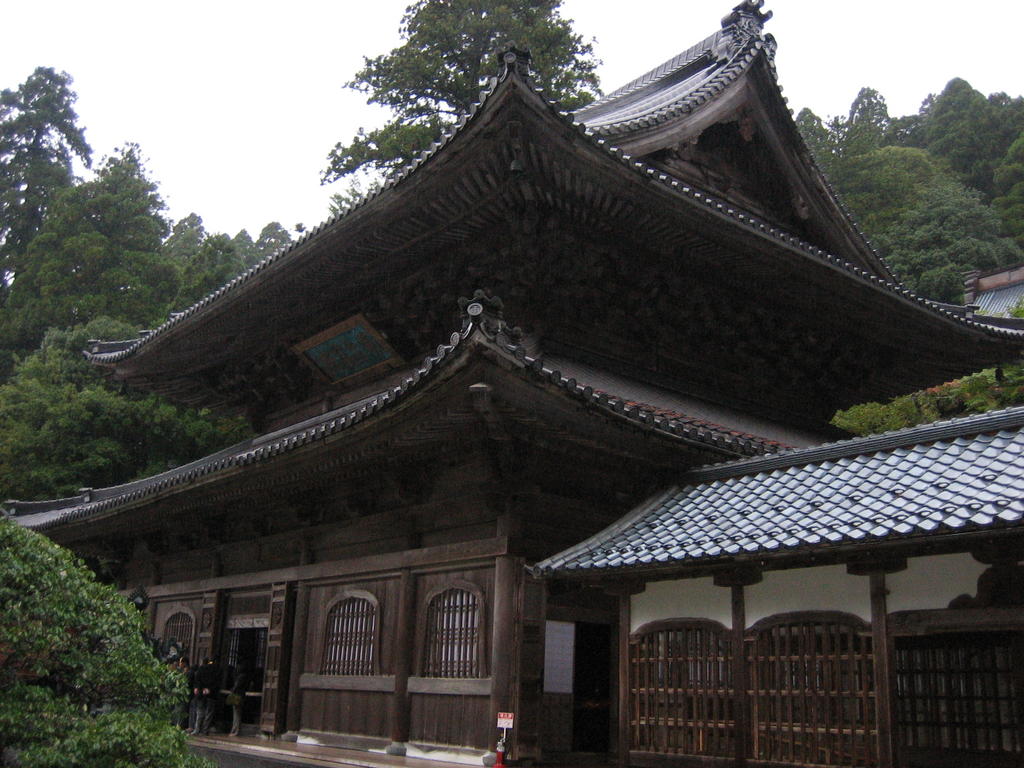
We drove up the mountain, disemarked from the bus and walked through the rather large courtyard into the entrance of the main building in the compound. Amidst other crowds of similarly curious tourists (more on that later), we were met by a monk (or, as they're officially called, priest trainee) and led to the fifth floor and into a large, empty tatami room. All of us (probably around 30 or so) were given small round pillows and told to sit on the ground, on knees at first, later lotus style. Meanwhile, the monk introduced the practice and launched us into a full on zazen session. Now, for me, the whole idea of tucking my large legs under me and sitting still (yes, just the mere idea) is a painful one and here we were, right smack in the middle, getting a brief taste of the monk's life. The first three minutes or so were ok. A little uncomfortable, but bearable. And then, the pain started. First, the thighs, then the lower back, then everything, just throbbing. (All of this comes from, I'm assuming, the lack of practice and perhaps stretching). After five minutes, I was ready to die, but it was a thirty minute session. I felt like I would just fall over at some point and lay there, unable to move, but using every ounce of concentration and energy I had, I focused on the pain, imagining it be temporary, unreal. Didn't help, perhaps made it stronger. And remember, the whole point is to eliminate all thought all together, focus on the stillness, nothingness all around. It was raining heavily outside and all that was audible was the water, slowly running down walls, splashing into puddles. Thirty people, sitting completely still. The energy in the room was incredible, the silence occasionally punctured by the obvious sound of someone getting hit with a large wooden stick (I'm still not sure who it was, but as you may know, this is a common practice in Zen, to snap people to attention.) It was the longest, most powerful and painful thirty minutes of my life, and when the bell came to end the session, I felt like it had only lasted 8 or 9 minutes. Wow. Certainly something to be tried again.
 After this, the monk led us on a tour of the monastery, which turned out to be absolutely huge. Many rooms, halls, monks walking around, leading other groups or engaging in all manner of chores. We saw the Founder's Hall, where Dogen's ashes (and of many successors) are kept in urns on prominent display. We saw the kitchen and numerous zazen halls. It was quite an elaborate construction, all devoted to this particular way of life. Utterly tremendous overall.
But, it did strike me just how many tourists there were, all having paid an admission price, all walking around hoping for a glimpse of a life they could never commit themselves to. And on top of that, the numerous stalls outside the monastery peddling all sorts of wares to these tourists. Yeah, on the one hand here is this 800 year old temple that has served as a center for enlightenment to so many aspiring Buddhists, and on the other its a commercial money-maker. Taints it a bit, but I won't go any further, because I have absolutely no right to pass judgment. Overall, I had a really refreshing time there and being inside such an institution was one reason for coming to Japan, so I'm fairly glad I got to do it. Oh, for those interested and planning on coming here, many of these types of monasteries, including this one, allow guests to stay in them and live like a monk for a day, two, or however many. It does not cost that much, but you do everything as the monks do, including zazen, eating, cleaning, etc. I'm planning on doing that soon and if anyone is interested, lets talk about it.
Ok. Enough out of me. Its been a long day, and a new week is about to start. Take care. Hope all is well.
Monday, October 17, 2005
Awe
Usually at night. Bonfires corner a tented ring, at the center of which lies a flattened mound of sand, with ropes marking the boundaries. Having just previously frequented the accompanying matsuri and dined on lovely Japanese okunomiyake or takoyaki or yakisoba or a variety of other freshly prepared dishes, the spectators slowly gather round, the luckier ones (or perhaps the ones with higher social standing) get the coveted three benches that line each side of the square. The PA comes on, squeaking out long passages, some devotional, some factual, but all with a deep air of tradition. Something hangs in the air, as if thousand year old rocks are about to come alive and grace those gathered here with their timeless presence. From the outsider's perspective, it does not, cannot, make logical sense. That which is unfolding is uniquely Japanese, uniquely tied to this land, to these people's hearts. I look, I see images, but there exists a missing link in my head. The PA quiets down, followed by a lonely drum beat. Soon, the silence is ruptured, as the taiko roars, and ten, twenty (one thousand) drummers unleash a violent sound storm into the night. The crowd hushes up, communally in awe. Any minute now it will begin and the anticipation is practically livid. The entrance to the big tent on the side slowly opens and from it emerge the starring attractions of the evening. Clad in extravagant kimonos, they slowly and determinedly, yet with an air of elegance, walk toward their stage, where for a few brief moments each of them will command the eyes, ears, and hearts of everyone present. The crowd admires, wihtout public judgment, even though privately all are making their bets. From appearances, it is difficult to tell who will be triumphant but all have been waiting a long time for this, eagerly preparing, anticipating. As the time nears for the starting gong, the kimonos are shed, revealing rather large human bodies, dressed in nothing but a thick strong cloth designed to cover the minimal and the most private part of the male anatomy. It turns out these are all kids, high school students, between 15 and 18 years of age, but from their size and demeanor, they almost look older, wiser. The referee, dressed in the most elaborate kimono of all, steps into the center of the ring and makes what appear to be introductory announcements. The gong sounds and the tournament begins. In all, there are probably fifty wrestlers, each of whom has committed (or perhaps sacrificed) his mind and body to this endeavor known as sumo, the national sport of Japan...
We all heard of it, some of us may have seen it on TV, if only for a few brief moments, but I don't think any of us, including myself, had the slightest idea about the importance, relevance, and esteem of this tradition in Japan. The most popular sport in Japan is, by far, baseball, an American import, which undoubtedly must be a bane to the pride of many Japanese. And so they revere sumo, which, with its more than a thousand year tradition, cannot be claimed by any other culture or nation. Originally closely linked to the Shinto faith, the sport has evolved to become a major phenomenon(The fact that, professionally, the sport is currently dominated by non-Japanese (with the rising star hailing from Bulgaria) must also cause some consternation, but nevertheless.) This is much more than a purely spectator sport, because intuitively it isn't all that much to look at. (I mean, and I say this without any offense, the main sight is two unusually fat men, wearing nothing but thick thongs, slapping, grabbing, hugging, and trying to lift the other out of the ring or drop them on the ground.) Because it is so wound up in tradition, because it has been happening for a very long time, and because it provides an occasion for local residents to come together and enjoy their community, it is inevitably reveered and will continue to thrive for a good long time to come. Surely, there is a professional aspect to it, just like any other major sport, but to become a sumo wrestler is to be respected, admired, and loved much more than a major league baseballer or NBAer. Training usually starts in elementary school and continues on through to high school. Naturally, many do not pursue it past that, but some do, and it comes to dominate an entire lifestyle. There's so much more to say, about all the rules, all the ranks, all the special moves, but that's for another time and place...
The first two fighters emerge, face each other. Each bows to their coaches, to the judges, to the referee. Each brushes aside some sand, goes down into the posture, slaps his thights, rises up again, walks up to the starting line. Again, they engage in ritual, eyeing each other all the while. Finally, they get in the ready stance, crouching, both fists firmly in the ground. The referee gives his mark, and they're off. It lasts but a few seconds, ending brusquely with a throw or a simply push. At the end, they both bow, the winner squats in victory. They walk off, and two more fighters emerge. The weeks and months of training are devoted to those few split seconds of glory, of ultimate reverence. As I have said before, it is beyond my comprehension, but well within the bounds of my awe...
http://www.absoluteastronomy.com/encyclopedia/s/su/sumo.htm
We all heard of it, some of us may have seen it on TV, if only for a few brief moments, but I don't think any of us, including myself, had the slightest idea about the importance, relevance, and esteem of this tradition in Japan. The most popular sport in Japan is, by far, baseball, an American import, which undoubtedly must be a bane to the pride of many Japanese. And so they revere sumo, which, with its more than a thousand year tradition, cannot be claimed by any other culture or nation. Originally closely linked to the Shinto faith, the sport has evolved to become a major phenomenon(The fact that, professionally, the sport is currently dominated by non-Japanese (with the rising star hailing from Bulgaria) must also cause some consternation, but nevertheless.) This is much more than a purely spectator sport, because intuitively it isn't all that much to look at. (I mean, and I say this without any offense, the main sight is two unusually fat men, wearing nothing but thick thongs, slapping, grabbing, hugging, and trying to lift the other out of the ring or drop them on the ground.) Because it is so wound up in tradition, because it has been happening for a very long time, and because it provides an occasion for local residents to come together and enjoy their community, it is inevitably reveered and will continue to thrive for a good long time to come. Surely, there is a professional aspect to it, just like any other major sport, but to become a sumo wrestler is to be respected, admired, and loved much more than a major league baseballer or NBAer. Training usually starts in elementary school and continues on through to high school. Naturally, many do not pursue it past that, but some do, and it comes to dominate an entire lifestyle. There's so much more to say, about all the rules, all the ranks, all the special moves, but that's for another time and place...
The first two fighters emerge, face each other. Each bows to their coaches, to the judges, to the referee. Each brushes aside some sand, goes down into the posture, slaps his thights, rises up again, walks up to the starting line. Again, they engage in ritual, eyeing each other all the while. Finally, they get in the ready stance, crouching, both fists firmly in the ground. The referee gives his mark, and they're off. It lasts but a few seconds, ending brusquely with a throw or a simply push. At the end, they both bow, the winner squats in victory. They walk off, and two more fighters emerge. The weeks and months of training are devoted to those few split seconds of glory, of ultimate reverence. As I have said before, it is beyond my comprehension, but well within the bounds of my awe...
http://www.absoluteastronomy.com/encyclopedia/s/su/sumo.htm
Saturday, October 08, 2005
Finally
I finally, after months of waiting and impatience, got internet at home. So, I'm a very happy camper and I would like to explore the whole skype thing if anyone is interested. Also, who does AIM? Anyone? Its nice and convenient and I got on there (SN is mjkteat). Let me know yours.
Ok. Off to KZ. Oh, put some new pics up, take a look, if you're interested...
http://public.fotki.com/PhotoMoose/romans/nippon_fall_2005/
Take care.
Ok. Off to KZ. Oh, put some new pics up, take a look, if you're interested...
http://public.fotki.com/PhotoMoose/romans/nippon_fall_2005/
Take care.
Thursday, October 06, 2005
Bit O' Travel
The last two weekends of my life have been spent away from home. A couple of weeks ago, some friends and I swung down to Nagoya, which is Japan’s third largest city. Let me tell you, after spending a few months in the countryside, it was really good to see the crowds again, and I do mean crowds in the mosh pit sense of the word. It was especially bad that weekend because it was the closing two days of the World Expo. For those of you not in the know, every five years, at some previously chosen point, there is a World Exposition. In 2000, it was held in Hanover, Germany, and in 2010 it will be in Shanghai, but this year (it opened in March) it was held in Aichi, Japan, which is just outside of Nagoya. Basically, it is a huge (we’re talking multiple square miles) area where various countries set up pavilions and display all kinds of things about themselves. It’s a chance for others who may not get a chance to travel much to see and learn about all parts of the world. But more on that in its chronological time and place. Friday was a day off, so we hopped on the bus in the morning and a short 3.5 hours later, we arrived in the heart of Nagoya. The rush of seeing thousands of people walking the streets made me feel somewhat alive, refreshed. It was definitely a good energy. We got on the metro and rode down to Sakae, the shopping district, to grab a bite to eat before heading to Nagoya Castle, one of the few “touristy” sight seeing attractions of the city (because the city fell victim to massive bombing raids during World War II, most of it had to be rebuilt, which would explain why most of the buildings are not more than fifty years old, a fact that explains Nagoya’s lack of standard “old” sightseeing attractions.) Naturally, we got there at 4:27 PM and the castle and the park surrounding it closed down at 4:30. So we took what glimpses we could and just sat around, waited for the sun to go down, got bit by these nasty little flies and headed off for the dining location for the evening, an Okinawan restaurant.
There, we were actually meeting some Japanese folks (Melanie’s (Melanie is one of the people we were with) ex-boyfriend is Japanese and lives in Nagoya and showed up with some of his friends to the restaurant)). At first, it was somewhat odd, because of the language barrier but the sake got going and seemed to at least melt it away a little bit. The food turned out to be not so good (but expensive enough to pretend to be good) and there was this one-man band there who sang Okinawan music, which was ok for about three songs, but then seemed like he put them on repeat. We finished up quickly and then were taken by Hiroshi (the ex-boyfriend) to this Australian bar down the street, which featured an eclectic mix of music as well as Japanese and foreigners. We hung there for three hours or so, continuing the merriment, getting to know each other, the locals, and even some other fellow JETS from the Nagoya area. It was actually a pretty good time and I got to know phone number number one for the weekend. At about 1:00 AM or so, we began the three hour search for the lodgings for the evening (remember that EXPO, yeah, everything was booked) which was to be that unique Japanese creation, the Love Hotel.
What is a love hotel? Well, in Japan, many young people live with their parents much longer than in other countries (probably due to a little bit of the “lack of vast open lands for people to live in” as well as Japan being quite a filial society). So, its quite common to find 20 somethings living with their parents and grandparents in the same house (hmm, I can say the same for myself) and obviously it would be quite a tricky feat to bring a loved one (or simply an attracted one) to the house and engage in acrobatics with one’s grandmother sleeping in the next room. Luckily, there’s a love hotel down the street where you can get a room by the hour or for the entire night. Another reason is that (and this is much more of a conjecture on my part) in Japan, the idea of fidelity is an important one on a very shallow level. In public appearance and within the realm of the “talked about,” yeah, everyone is faithful, involved in deeply committed, loyal, treasured relationships and marriages. But, within the more hush, hush private realm, this is highly not the case. Cheating, in fact, is quite common and even perhaps acceptable and tolerated, as long as it is not openly talked about, takes place out of sight, out of mind, and is kept purely between the two (or more) committing the act. Something everybody knows, no one will admit, and it continues to operate, and a love hotel is a perfect invention to keep this mechanism going. The basic set up is the following. Outside urban centers, the building has as many garages as it has rooms. You pull into a garage, you walk up a set of stairs, and you go into your room (all the rooms are unlocked). Once you are in, you are locked in until you choose to leave. (There is no checking into a love hotel, there is no come and go as you please). In more urban spots, you park in a communal garage, but there is a separate in and out elevator, so you never have to cross paths with anyone coming out. Once inside, the rooms are actually quite nice. They are super clean (another amazing feat of Japanese technical wizardry) and contain all the amenities suitable to living up to the name of the institution. Once you are finished with the room, you leave and pay for the time you were in there (its all electronically monitored through the opening and closing of the door) through a slot in the wall. Slide money in, leave, and no one knows any different…conclude what you will…
Since they are cheaper than regular hotels, we had decided that it would be a convenient place to spend the night. They are usually pretty easy to spot, as they are decorated with all kinds of crazy neon signs and have strange architecture, as well as ringer names like “Malibu Oasis” or “Heaven Hotel.” The first one we went to was all filled up, completely. In the lobby, there were several waiting rooms, but we decided that it might be a long wait. The second had a Ferrari F-150 standing behind a glass case in the garage, but it too turned out to be quite full. At this point, we assumed that all the ones in the downtown area would be full, so we began to make our way out to the suburbs, which would be closer to next day’s destination anyway. Two or three hotels later, we finally found one that had vacancies (thank god for those Japanese friends, who literally drove around for like two, three hours trying to find a bunch of foreigners a love hotel). It was an individual garage set up and we finally got up to our room, which we would be sharing between five people. The room had a small living room area with a T.V. and a fridge containing a number of “things” other than the usual hotel fridge fare. The bathroom was nice, all granite and stone like, with a huge shower area and a rather big Jacuzzi. But the highlight was the bedroom. Literally, every inch of the walls and ceilings were covered with mirrors (even the windows were mirrored); never quite been in a room like it. The bed was a king and had speakers and stereo built in. On the whole a rather nice room, except we couldn’t figure out how to turn off the A/C, so it got quite cold. We slept for about four hours, before setting off for the EXPO. (As a side note, many of these hotels come with themed rooms – i.e. ocean, jungle, Paris, use your imagination.)
Since we were in the middle of nowhere and didn’t really know how to get to where we were going, we had to hitch hike. (Here’s a lovely picture for you – six foreigners standing outside of a Love Hotel, trying to flag down a car). After only five minutes, a nice Japanese man in a van pulled over and offered to drive us to the train station, which we discovered was for a railroad (an elevated monorail) that was built specifically for the EXPO. We got to the grounds (which were humongous), queued up, and got in. First thing we did was to ride the aerial gondolas to get an idea of what we were up against. They took us across the entire expo and upon disembarking, we ended up right next to the Russian pavilion (yeah baby) and so that was our first stop. The theme of this EXPO was the environment and conservation and all that good stuff, so many of the pavilions were devoted to exhibiting what particular countries are doing for this cause. The Russian one wasn’t all that interesting, actually, so it proved to be a quick breeze. From there, it was on to the UK, Switzerland, Holland (yeah baby), Africa (funny how all these countries get their own pavilion, and then there’s the country of Africa.) We had some pretty good African food (ostrich curry, I didn’t know they had ostriches in Africa). Among others we visited were Germany, Spain, Iran, Nepal, India, China, Qatar (yeah, that’s a country), Australia, and my personal favorite, Bhutan (a tiny Buddhist country up in the Himalayas). It would be too much to go into details here about all these pavilions (if you’re interested, then google “World Expo 2005 Aichi”) but I will make a number of remarks. First, we saw only a brief part of the Expo and it would literally take days to see the whole thing because it was so huge. Second, because it was the second to the last day (of an EXPO that started last March) there were approximately a billion people there, which meant that the lines to get into these pavilions were quite long, and very reminiscent of waiting for the rides at Great America. But, in many cases we avoided that problem, because between us we had seven languages with some level of conversation, and so we sweet talked our way into some pavilions without having to wait at all. These pavilions were run by people from those countries. The German case was most striking, where the line was 3.5 hours (yeah, 3.5 hours). Two of the girls we were with spoke German and flirted with the German fellow at the front and we got in after only five minutes. I actually felt quite guilty walking in front of all these poor Japanese who had been standing in line for so long. But, so be it… Third, it was interesting to see that the richer countries could afford to make highly elaborate displays actually having to do with the environment, etc. while the poorer ones were mostly bazaars, selling stuff from their countries for excessively inflated prices (i.e. Nepal, where I briefly considered buying an elaborate mandala that would have run me about $100). After an exhausting day, we made our way back into the city, got freshened up in the subway bathroom, and tried booking a room at the Hilton for a healthy $279/night. But, alas, they were booked up as well and we were left with a night on the town.
We met up another friend of Melanie’s (the soon to be phone number number three) and headed for our destination for the evening, the id Bar. On our way, we stopped over at an amusement arcade (a whole other entry at some point in the future) where we went to the photo booths for some pictures. These are not like the photo booths that you know. They are quite spacious (could fit up to eight people) and afterwards you can add a gajillion effects and alterations to your photos, print them, email them, probably animate them, and all sorts of other business. Here, I met phone number number two and her friend, and we took some pictures. Fun times. Finally, we got to the club, sorted out our luggage in the lockers, and began to properly enjoy the night. It was one of those four story things, where each story has a bar and a dj is spinning a different type of music. We chilled in the basement for a while, where it was mostly 80s stuff, including Thriller. Then, up to the first floor, where there was some trance and house (yeah, baby, yeah). It was amazing to see Japanese people dance to this stuff. There was a bit of a state, which was actually a series of long steps, and the dancers lined up on it and faced the crowd. Each had a glow stick or two and they danced in complete uniformity to the music. It was hot and sweaty and an entirely really good time (best time I’ve had out dancing in a while…) At around 2:00, the place shut, and we left, walking the streets of Nagoya, enjoying the night with its denizens. Feeling a bit of the old hunger, we went to (drum roll please), Denny’s. The mere sight of it got me really excited because I have been dreaming of a Moons over my Hammy for quite some time, but it turned out to serve Japanese food, plus some strange pasta dishes, with the only similarity with its American counterpart being a side of French toast. But, food is food and it had to do. At a healthy 3:30, it was time to find a place to crash, and what better place to do so than a 24 hour karaoke parlor, where you rent a room by the hour to sing your heart away. Of course we didn’t realize that the room would be the size of a prison cell, perfect for singing and drinking, not quite so right for housing six people for the night. But, there was no choice, we laid out how we could, three on the floor (me by the door, two underneath the table) and three on the little benches that lined the wall. Let me tell you it was the most atrocious sleeping experience I’ve had in a while, but we shared it all together and actually managed to get some hours of sleep. (And we didn’t even bother singing). The next day, we had a nice traditional Japanese breakfast, headed to the bus station and some hours later, came back to sleepy, old Ishikawa, to conclude an exhausting but thoroughly enjoyable weekend. Definitely will go back to Nagoya at some point as it was a very nice city and why not put those phone numbers to good use?
And just as you thought this intolerably long blog was coming to its conclusion, there’s still a whole other weekend to write about, last weekend. But I’ll make it as short and brief as possible… I went to Nagano (the site of the ’98 Winter Olympics) where there was an all Japan ALT soccer tournament. Basically, every prefecture (i.e. Ishikawa, sort of like the states in the US) has ALTs (me, Assistant Language Teacher), and some of them get together to start up a soccer team (both boys and girls have their own team). And so the Ishikawa team, along with about twenty or so others got together in Nagano for a two days soccer tourney. Our team isn’t very good and I’m not even on it, but I got bamboozled into going as a spectator and a cheerer. It was about a four hour drive, and it turned out to be not in Nagano proper, but in the mountains just outside of the city (a hell of a ways up in the mountains, in fact, where a nice big plateau housed a bunch of hotels and soccer pitches). The first night was all strategy and getting some rest. The next day, Saturday, soccer was played all day. I watched a girls’ match (I’m sorry, but it was utterly pathetic) and four of the boys’ matches, which were actually enjoyable to watch. Our boys team (historically highly bad) actually managed to win one of these, but it was hard work. That night, the hotel hosted a party for us (there were like three hundred people) and being there actually felt like being back home (its funny how that sometimes happens, especially when I’m surrounded by other foreigners, I briefly forget where I am, and when I do remember, its quite a shock.) Everyone was quite exhausted, except me, who had done nothing but lounge around all day on the grass and yell occasional “I say Ishi, you say Kawa – Ishi, Kawa.” The dj was kind of crap and so many congregated outside, talked, relaxed, and even though the whole thing was a disgusting meat market, I did manage to meet some nice interesting people. Hm, where did Roman spend the night?
The next day was the elimination tournament and both of our teams got through one game before being eliminated. We ate some kareraisu for lunch (pronounce that slowly several times and you’ll figure out what it is) and headed home. On the way, we got a speeding ticket (a big no no in Japan, I wasn’t driving luckily), and the fine was a whopping $350 for going like 30 km over. Anyway, another long, happy weekend in Japan, returning to the countryside and resuming the responsible working life. Ok, I think I have exhausted myself writing this (but it has to be the longest blog ever). If fact, I doubt that anyone got this far…
Anyway, hope all are well. Missing the home land. This weekend, I’m off to Osaka, for a concert. Sooo excited. The OFFSPRING baby. Yeah, baby. Yeah, baby. When we went to buy tickets for the show, they were almost sold out and they could only sell individual tickets, as there were no seats left that were together. So we buy one, and kaboom, its sold out. And who got that last ticket? Yeah, baby. Terribly excited. And plus I get to see Osaka…
Ok, boys and girls, take care of yourselves and go do something productive… Much love…
P.S. Read Mr. Murakami’s “The Kidney Shaped Stone That Moves” in the New Yorker. Its quite good. In other Murakami news, sometime next year, he will release another volume of short stories in the U.S.. In Japan, he has either recently published or will soon publish his newest novel, After Dark. Who knows when that’ll be translated, but hopefully soon, but not before the next TOOL disc. Ok, ok, I’m done, I’m done. Out.
There, we were actually meeting some Japanese folks (Melanie’s (Melanie is one of the people we were with) ex-boyfriend is Japanese and lives in Nagoya and showed up with some of his friends to the restaurant)). At first, it was somewhat odd, because of the language barrier but the sake got going and seemed to at least melt it away a little bit. The food turned out to be not so good (but expensive enough to pretend to be good) and there was this one-man band there who sang Okinawan music, which was ok for about three songs, but then seemed like he put them on repeat. We finished up quickly and then were taken by Hiroshi (the ex-boyfriend) to this Australian bar down the street, which featured an eclectic mix of music as well as Japanese and foreigners. We hung there for three hours or so, continuing the merriment, getting to know each other, the locals, and even some other fellow JETS from the Nagoya area. It was actually a pretty good time and I got to know phone number number one for the weekend. At about 1:00 AM or so, we began the three hour search for the lodgings for the evening (remember that EXPO, yeah, everything was booked) which was to be that unique Japanese creation, the Love Hotel.
What is a love hotel? Well, in Japan, many young people live with their parents much longer than in other countries (probably due to a little bit of the “lack of vast open lands for people to live in” as well as Japan being quite a filial society). So, its quite common to find 20 somethings living with their parents and grandparents in the same house (hmm, I can say the same for myself) and obviously it would be quite a tricky feat to bring a loved one (or simply an attracted one) to the house and engage in acrobatics with one’s grandmother sleeping in the next room. Luckily, there’s a love hotel down the street where you can get a room by the hour or for the entire night. Another reason is that (and this is much more of a conjecture on my part) in Japan, the idea of fidelity is an important one on a very shallow level. In public appearance and within the realm of the “talked about,” yeah, everyone is faithful, involved in deeply committed, loyal, treasured relationships and marriages. But, within the more hush, hush private realm, this is highly not the case. Cheating, in fact, is quite common and even perhaps acceptable and tolerated, as long as it is not openly talked about, takes place out of sight, out of mind, and is kept purely between the two (or more) committing the act. Something everybody knows, no one will admit, and it continues to operate, and a love hotel is a perfect invention to keep this mechanism going. The basic set up is the following. Outside urban centers, the building has as many garages as it has rooms. You pull into a garage, you walk up a set of stairs, and you go into your room (all the rooms are unlocked). Once you are in, you are locked in until you choose to leave. (There is no checking into a love hotel, there is no come and go as you please). In more urban spots, you park in a communal garage, but there is a separate in and out elevator, so you never have to cross paths with anyone coming out. Once inside, the rooms are actually quite nice. They are super clean (another amazing feat of Japanese technical wizardry) and contain all the amenities suitable to living up to the name of the institution. Once you are finished with the room, you leave and pay for the time you were in there (its all electronically monitored through the opening and closing of the door) through a slot in the wall. Slide money in, leave, and no one knows any different…conclude what you will…
Since they are cheaper than regular hotels, we had decided that it would be a convenient place to spend the night. They are usually pretty easy to spot, as they are decorated with all kinds of crazy neon signs and have strange architecture, as well as ringer names like “Malibu Oasis” or “Heaven Hotel.” The first one we went to was all filled up, completely. In the lobby, there were several waiting rooms, but we decided that it might be a long wait. The second had a Ferrari F-150 standing behind a glass case in the garage, but it too turned out to be quite full. At this point, we assumed that all the ones in the downtown area would be full, so we began to make our way out to the suburbs, which would be closer to next day’s destination anyway. Two or three hotels later, we finally found one that had vacancies (thank god for those Japanese friends, who literally drove around for like two, three hours trying to find a bunch of foreigners a love hotel). It was an individual garage set up and we finally got up to our room, which we would be sharing between five people. The room had a small living room area with a T.V. and a fridge containing a number of “things” other than the usual hotel fridge fare. The bathroom was nice, all granite and stone like, with a huge shower area and a rather big Jacuzzi. But the highlight was the bedroom. Literally, every inch of the walls and ceilings were covered with mirrors (even the windows were mirrored); never quite been in a room like it. The bed was a king and had speakers and stereo built in. On the whole a rather nice room, except we couldn’t figure out how to turn off the A/C, so it got quite cold. We slept for about four hours, before setting off for the EXPO. (As a side note, many of these hotels come with themed rooms – i.e. ocean, jungle, Paris, use your imagination.)
Since we were in the middle of nowhere and didn’t really know how to get to where we were going, we had to hitch hike. (Here’s a lovely picture for you – six foreigners standing outside of a Love Hotel, trying to flag down a car). After only five minutes, a nice Japanese man in a van pulled over and offered to drive us to the train station, which we discovered was for a railroad (an elevated monorail) that was built specifically for the EXPO. We got to the grounds (which were humongous), queued up, and got in. First thing we did was to ride the aerial gondolas to get an idea of what we were up against. They took us across the entire expo and upon disembarking, we ended up right next to the Russian pavilion (yeah baby) and so that was our first stop. The theme of this EXPO was the environment and conservation and all that good stuff, so many of the pavilions were devoted to exhibiting what particular countries are doing for this cause. The Russian one wasn’t all that interesting, actually, so it proved to be a quick breeze. From there, it was on to the UK, Switzerland, Holland (yeah baby), Africa (funny how all these countries get their own pavilion, and then there’s the country of Africa.) We had some pretty good African food (ostrich curry, I didn’t know they had ostriches in Africa). Among others we visited were Germany, Spain, Iran, Nepal, India, China, Qatar (yeah, that’s a country), Australia, and my personal favorite, Bhutan (a tiny Buddhist country up in the Himalayas). It would be too much to go into details here about all these pavilions (if you’re interested, then google “World Expo 2005 Aichi”) but I will make a number of remarks. First, we saw only a brief part of the Expo and it would literally take days to see the whole thing because it was so huge. Second, because it was the second to the last day (of an EXPO that started last March) there were approximately a billion people there, which meant that the lines to get into these pavilions were quite long, and very reminiscent of waiting for the rides at Great America. But, in many cases we avoided that problem, because between us we had seven languages with some level of conversation, and so we sweet talked our way into some pavilions without having to wait at all. These pavilions were run by people from those countries. The German case was most striking, where the line was 3.5 hours (yeah, 3.5 hours). Two of the girls we were with spoke German and flirted with the German fellow at the front and we got in after only five minutes. I actually felt quite guilty walking in front of all these poor Japanese who had been standing in line for so long. But, so be it… Third, it was interesting to see that the richer countries could afford to make highly elaborate displays actually having to do with the environment, etc. while the poorer ones were mostly bazaars, selling stuff from their countries for excessively inflated prices (i.e. Nepal, where I briefly considered buying an elaborate mandala that would have run me about $100). After an exhausting day, we made our way back into the city, got freshened up in the subway bathroom, and tried booking a room at the Hilton for a healthy $279/night. But, alas, they were booked up as well and we were left with a night on the town.
We met up another friend of Melanie’s (the soon to be phone number number three) and headed for our destination for the evening, the id Bar. On our way, we stopped over at an amusement arcade (a whole other entry at some point in the future) where we went to the photo booths for some pictures. These are not like the photo booths that you know. They are quite spacious (could fit up to eight people) and afterwards you can add a gajillion effects and alterations to your photos, print them, email them, probably animate them, and all sorts of other business. Here, I met phone number number two and her friend, and we took some pictures. Fun times. Finally, we got to the club, sorted out our luggage in the lockers, and began to properly enjoy the night. It was one of those four story things, where each story has a bar and a dj is spinning a different type of music. We chilled in the basement for a while, where it was mostly 80s stuff, including Thriller. Then, up to the first floor, where there was some trance and house (yeah, baby, yeah). It was amazing to see Japanese people dance to this stuff. There was a bit of a state, which was actually a series of long steps, and the dancers lined up on it and faced the crowd. Each had a glow stick or two and they danced in complete uniformity to the music. It was hot and sweaty and an entirely really good time (best time I’ve had out dancing in a while…) At around 2:00, the place shut, and we left, walking the streets of Nagoya, enjoying the night with its denizens. Feeling a bit of the old hunger, we went to (drum roll please), Denny’s. The mere sight of it got me really excited because I have been dreaming of a Moons over my Hammy for quite some time, but it turned out to serve Japanese food, plus some strange pasta dishes, with the only similarity with its American counterpart being a side of French toast. But, food is food and it had to do. At a healthy 3:30, it was time to find a place to crash, and what better place to do so than a 24 hour karaoke parlor, where you rent a room by the hour to sing your heart away. Of course we didn’t realize that the room would be the size of a prison cell, perfect for singing and drinking, not quite so right for housing six people for the night. But, there was no choice, we laid out how we could, three on the floor (me by the door, two underneath the table) and three on the little benches that lined the wall. Let me tell you it was the most atrocious sleeping experience I’ve had in a while, but we shared it all together and actually managed to get some hours of sleep. (And we didn’t even bother singing). The next day, we had a nice traditional Japanese breakfast, headed to the bus station and some hours later, came back to sleepy, old Ishikawa, to conclude an exhausting but thoroughly enjoyable weekend. Definitely will go back to Nagoya at some point as it was a very nice city and why not put those phone numbers to good use?
And just as you thought this intolerably long blog was coming to its conclusion, there’s still a whole other weekend to write about, last weekend. But I’ll make it as short and brief as possible… I went to Nagano (the site of the ’98 Winter Olympics) where there was an all Japan ALT soccer tournament. Basically, every prefecture (i.e. Ishikawa, sort of like the states in the US) has ALTs (me, Assistant Language Teacher), and some of them get together to start up a soccer team (both boys and girls have their own team). And so the Ishikawa team, along with about twenty or so others got together in Nagano for a two days soccer tourney. Our team isn’t very good and I’m not even on it, but I got bamboozled into going as a spectator and a cheerer. It was about a four hour drive, and it turned out to be not in Nagano proper, but in the mountains just outside of the city (a hell of a ways up in the mountains, in fact, where a nice big plateau housed a bunch of hotels and soccer pitches). The first night was all strategy and getting some rest. The next day, Saturday, soccer was played all day. I watched a girls’ match (I’m sorry, but it was utterly pathetic) and four of the boys’ matches, which were actually enjoyable to watch. Our boys team (historically highly bad) actually managed to win one of these, but it was hard work. That night, the hotel hosted a party for us (there were like three hundred people) and being there actually felt like being back home (its funny how that sometimes happens, especially when I’m surrounded by other foreigners, I briefly forget where I am, and when I do remember, its quite a shock.) Everyone was quite exhausted, except me, who had done nothing but lounge around all day on the grass and yell occasional “I say Ishi, you say Kawa – Ishi, Kawa.” The dj was kind of crap and so many congregated outside, talked, relaxed, and even though the whole thing was a disgusting meat market, I did manage to meet some nice interesting people. Hm, where did Roman spend the night?
The next day was the elimination tournament and both of our teams got through one game before being eliminated. We ate some kareraisu for lunch (pronounce that slowly several times and you’ll figure out what it is) and headed home. On the way, we got a speeding ticket (a big no no in Japan, I wasn’t driving luckily), and the fine was a whopping $350 for going like 30 km over. Anyway, another long, happy weekend in Japan, returning to the countryside and resuming the responsible working life. Ok, I think I have exhausted myself writing this (but it has to be the longest blog ever). If fact, I doubt that anyone got this far…
Anyway, hope all are well. Missing the home land. This weekend, I’m off to Osaka, for a concert. Sooo excited. The OFFSPRING baby. Yeah, baby. Yeah, baby. When we went to buy tickets for the show, they were almost sold out and they could only sell individual tickets, as there were no seats left that were together. So we buy one, and kaboom, its sold out. And who got that last ticket? Yeah, baby. Terribly excited. And plus I get to see Osaka…
Ok, boys and girls, take care of yourselves and go do something productive… Much love…
P.S. Read Mr. Murakami’s “The Kidney Shaped Stone That Moves” in the New Yorker. Its quite good. In other Murakami news, sometime next year, he will release another volume of short stories in the U.S.. In Japan, he has either recently published or will soon publish his newest novel, After Dark. Who knows when that’ll be translated, but hopefully soon, but not before the next TOOL disc. Ok, ok, I’m done, I’m done. Out.
Subscribe to:
Posts (Atom)